

Salmon
Salmon help forests grow! Learn how here
Salmon have and continue to be an important part of Washington life. They are important food sources for many other animals on land, in freshwater, and in saltwater. Because Native Peoples who lived in this area relied on salmon as an important food source, salmon also became an important part of native culture. It remains an important part of the history and culture of Washington today.
Salmon are part of the family Salmonidae which also includes trout and charr. Often members of this family are referred to as “Salmonids.” Many of the fish in this family are anadromous, meaning they spend time both in salt and fresh water. In order to do this, their body must go through changes so they can survive in each habitat.
Types of Salmon in WA
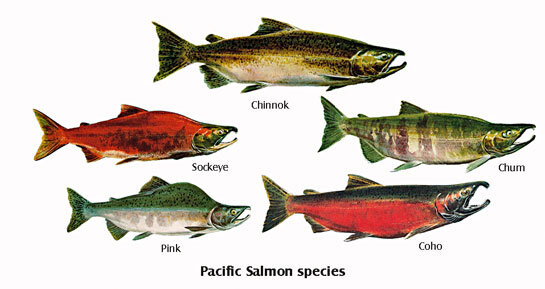
Pacific Salmon in Spawning form Photo: https://www.sanctuaryasia.com/magazines/talkin-tigers/9581-the-pacific-salmons-journey.html
There are 5 salmon species in Washington. An fun way to remember them is relating the types of salmon to each finger on your hand. Hold out one hand and with your other hand point to your thumb. Your thumb represents the Chum Salmon because Chum and thumb rhyme. Chum Salmon are sometimes called Dog Salmon probably because the spawning males develop teeth that kind of look like canine teeth. Point to your pointer finger. With this finger you could accidentally “sock yourself in the eye” so it stands for the Sockeye Salmon. Young Sockeye salmon live in lakes for up to two years before migrating to the ocean. Point to your middle finger. Because this is your tallest finger it represents the largest salmon species, Chinook Salmon. Sometimes these salmon are known as King Salmon and they are the preferred food of our resident population of Orcas. Next is your ring finger. Because you might place a silver ring on this finger, it represents the “Silver Salmon,” also known as Coho Salmon. These salmon often spawn in small streams that are close to neighborhoods, making them a popular sport fish. Lastly, your pinky finger represents the Pink Salmon. These salmon develop a hump in their spawning form, earning the nickname “Humpback Salmon.” They also only spawn in odd years because they have a very regular life cycle where they return to their home stream to spawn after living in the ocean for 2 years. There are 3 other Salmonids native to Washington: Steelhead, Bull Trout and Cutthroat.
Salmon Life Cycle

All species of salmon have a slightly different life cycle. They may spend more time in one stage than other salmon do. This is the general life cycle of salmon: Salmon start their lives as eggs in the gravel of a stream bed. Once they hatch, they still have their yolk sac and they use this as nutrients to grow larger. This stage is called the alevin. Once their yolk sac is absorbed, they become fry and need to start finding their own food. They eat freshwater invertebrates. When the salmon start heading to saltwater, their body starts going through a process called “smoltification” so they can survive in the salty water. This next stage is therefore called a smolt. Estuaries, like the Puget Sound, are incredibly important transition zones between fresh and salt water for this stage of salmon. Eventually the salmon becomes an adult, living a portion of its life in the ocean. When it is time to spawn, or lay eggs, salmon pass through the estuary again and their body changes to tolerate the saltwater. They are able to locate the same stream they were hatched in through their sense of smell! At this time, the salmon stops eating, mates, and finds a place to lay their eggs. After they lay their eggs, the salmon’s journey is over and they die.
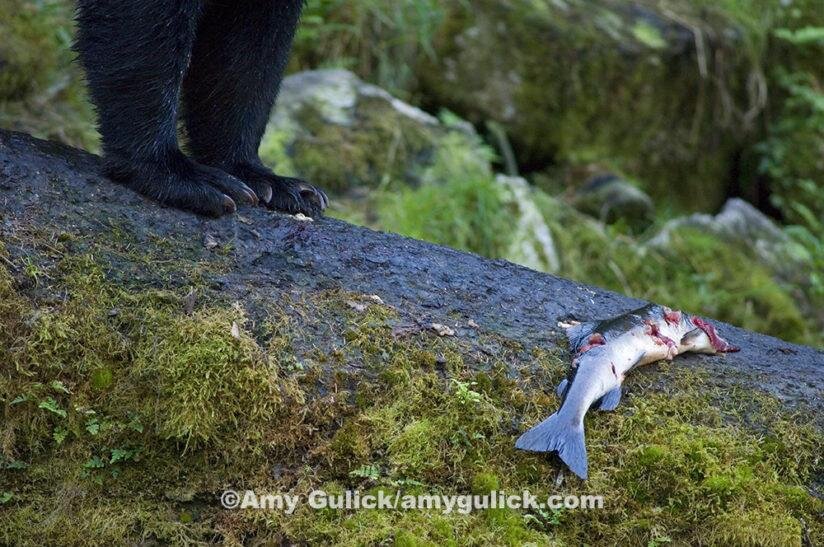
So how exactly do Salmon help forests grow?
A salmon’s life is not an easy one. They face multiple predators throughout their life cycle including: birds, bears, other fish, sharks, orcas, and humans. On top of this, salmon are also facing man-made threats of habitat destruction, pollution, dams, and overfishing. A spawning salmon may lay somewhere between 1,500 to 10,000 egg and only around 10 will survive to reproduce. So what do salmon have to do with the forest? As salmon are hunted by land predators such as birds and bears, these predators carry the salmon on to land. They may not always finish their meal, leaving food for other animals such as foxes, raccoons and invertebrates. The rotting fish as well as the waste the animals produce after eating the fish give nutrients (mainly nitrogen) to the soil in the forest, helping many plants grow. After a salmon spawns, they also end up on riverbanks to be decomposed and turned into nutrients that feeds the plants of the forest. So salmon are not only important food sources for many animals, they also help feed the trees! Learn more here: https://www.kqed.org/science/1915421/theres-something-fishy-about-these-trees-deep-look

10 Essentials for Outdoor Adventuring
What should you bring once you can resume adventuring outdoors?
Many are looking forward to the outdoor adventures they will get to have once they are able to again. Whether you are looking forward to camping, hiking, or backpacking, you can start preparing for your adventure now by making (or making a plan for) your 10 essential sets of items. The 10 essentials are items that are fantastic to have with you whenever you spend time outdoors. They help you stay prepared for emergencies, weather changes, staying out longer than you thought you were going to, and more. This is also an excellent way to follow the first Leave No Trace guideline: “Plan Ahead and Prepare.” Read more about Leave No Trace here: http://www.soundviewcamp.com/nature-blog/2020/4/3/leave-no-trace
The 10 essential sets of items include: navigation, source of light, sun protection, first aid kit, repair kit/tools, extra clothes, fire kit, shelter, extra food, and extra water. Though you may not need all of these thing on every hike, the one time you might, you will be glad you have them. You never know when that one time will be, so it is a great idea to have your 10 essentials for every adventure.

1. Navigation
Part of planning ahead is learning about the area you plan to explore. This involves getting a map of the area in which you are hiking or camping. While using your phone or a GPS can be fun and helpful, you do not want to rely on them in an emergency because the battery could run out or it could lose signal. Therefore, before you leave, familiarize yourself with the map and the path you plan to follow. Another great navigational tool is a compass. Make sure you learn how to use the compass before bringing it on your trip! Maps and compasses work best together.
2. Source of Light
A flashlight or a headlamp are great portable sources of light. Even if you are hiking during the middle of the day, it is a good idea to bring one of these sources of light so if you spend more time outside than you were planning, like if you get lost or someone gets hurt, you will be prepared to see in the dark. They can also be used to get someone’s attention in case of an emergency. Always be sure you have a working extra set of batteries for your light source. Headlamps give you the advantage of having your hands free when you are using it.
3. Sun Protection
Even on a cloudy day, you can get a sunburn. While sunshine offers many benefits, too much of it can be harmful to our bodies. Sun protection can take many forms: sunscreen, hat, sunglasses, and protective clothing. The best option is to use many of these things to protect your body from harmful effects of the sun. Remember to apply your sunscreen before heading out and to reapply every 2 hours.

A few of the things in my basic day hiking first aid kit
4. First Aid Kit
I have used my first aid kit many times on trail. Sometimes for myself, but more often to help fellow hikers on the trail. Depending on the length of your trip and the number of people coming with, you may need different things in your first aid kit. There are many pre-made kits you can get at the store. I always make sure to carry adhesive bandages of different sizes (band-aids), an elastic bandage (for wrapping hurt limbs), blister prevention supplies (mole skin, medical tape), tweezers (for splinters), and insect repellent (to prevent itchy bug bites). Make sure with your first aid kit, you bring a knowledge of how to use what is inside. It is a great idea to have someone trained in first aid with you when you hike!
5. Repair Kit/Tools
This will change based on what you are bringing with you. In general, it is a great idea to carry some duct tape and a multi-tool with scissors and a knife (with parent permission). I often will wrap a few layers of duct tape around a pencil or my water bottle so I don’t have to bring a full roll. You may also want a patch kit for your rain gear or tent if you are on an overnight trip. String is also a helpful repair item. If you bring the right string, it can help start a fire as well.

My headlamp and batteries for source of light. String, needle and thread, hair ties, and duct tape for my repair kit. Matches, water-proof container and a fire starter for my fire kit. An emergency blanket for my shelter.
6. Fire Kit
Just like your first aid kit and compass should also include knowledge of how to use it, you should be familiar with starting a safe, controlled fire before using a fire kit. Otherwise, you can make sure an adult coming with you has a fire kit with them. Check out our lesson on fire building here: http://www.soundviewcamp.com/nature-blog/2020/4/8/fire-building In you fire kit, you should have matches in a water-proof container, and some supplies to use as dry tinder. Fires provide light and warmth in case of emergencies. Make sure to follow the “Minimize Fire Impacts” Leave No Trace principle anytime you have a fire.
7. Extra Clothes
Weather can be unpredictable. Even with a low chance of rain for the day, you may find yourself out in the rain or in some more wind than you expected. For this reason, always bring some extra clothes to protect you from the elements. Hats, gloves, and an extra clothing layer are all great things to have with you. A waterproof layer can not only keep you dry but also protect you from the wind and keep you a little warmer.
8. Shelter
This one will look different based on the type of trip you are taking. If you are camping or backpacking your shelter will be the tent that you are taking with you. For a day hike, bringing a light weight emergency blanket or a bivy sack, maybe helpful in case you get lost or stuck longer than you were expecting.
9. Extra Food
When I go on a day hike, I enjoy eating lunch on the trail. My lunch however does not count as my extra food for my 10 essentials. On top of what I bring for lunch, I pack some extra nutrition just in case I am on trail longer than I expect. This food is generally something high in protein so it will stick with me a while. Energy bar, trail mix, and jerky are all good options because they are not too heavy and do not require refrigeration or cooking.

10. Extra Water
Staying hydrated effects your whole outdoor experience. Drinking enough water prevents headaches, cramps, grumpiness and more. Because you are being active, you may need more water than you typically drink in a day. How much water you need changes depending on the season. When it is hot out, your body loses water faster and you need to drink more to replace it. Make sure you always bring more water than you will need. For hikes more than 2 hrs, I usually carry 2 full 32oz water bottles but water requirements for everyone are a little different. If you are going on a long overnight or multi-night trip, you may need a water purifier to replenish your water supply.
The 10 essentials offer great guidelines for what to pack on your trip. If you have some of these things lying around the house, you can practice carrying them on neighborhood walks. You can also split many of these things up among your adventuring group, like the first aid kid, repair kit, fire kit, navigation, and shelter. Make sure you talk with your adventure group about these things while planning your trip! Learn more about the 10 essentials here: https://www.nps.gov/articles/10essentials.htm

Orcas: Part 2
Learn more about Orcas here

Check out some hunting strategies here: https://www.pbs.org/wnet/nature/killer-whales-killer-weapon-brain/11352/
Yesterday we started talking about Orcas and learned what kind of animal they are as well as the 3 different populations of Orcas that can be seen in Washington. If you missed that you can see it here: http://www.soundviewcamp.com/nature-blog/2020/4/27/orcas
Today we will learn more about Orcas, including how they hunt and what threats they face.
Hunting tactics
Orcas are known as apex predators because they are the top of the food chain. No other animal hunts them (other than humans…but that was mainly in the past). Like all other predators, Orcas help keep populations of other animals healthy because they are more likely to catch sick and old animals. Depending on the population of Orcas, they hunt a wide variety of animals from large fish to marine mammals to the occasional sea bird. Orcas are also incredibly intelligent and social. They use this to their advantage when hunting. While different populations of Orcas may have different specific strategies to catch their food, they all share a few common traits. One of these is that they all use echolocation to find their food. To do this, they make a sound that carries through the water. That sound wave will bounce off something nearby and return to the Orca. This tells the Orca how far the object is and it may even give some clues to what the object is. When a pod of Orcas finds food, they will work together to catch it. Communicating through clicks and whistles, they can work together to round up their prey. Each family group uses slightly different sounds to communicate to each other. They have large cone shaped teeth that interlock, helping the Orcas keep hold of their prey when they catch it. They also may use their tail to stun their prey before catching it.

Threats Orcas Face

Even though Orcas are not being hunted by other animals, they still face threats to their survival. The overall conservation status of Orcas as a species is somewhat unknown. Locally, the Southern Resident Orcas are considered endangered. One of the major threats they face is a lack of food. Because these Orcas primarily dine on salmon, their health is closely linked with the health of the Chinook Salmon population. The salmon population has been declining due to over-fishing and habitat destruction. This connects us back to the post on watersheds (http://www.soundviewcamp.com/nature-blog/2020/4/9/watersheds ) because salmon rely on healthy rivers in order to spawn, create more salmon. Therefore, the health of the rivers that the Chinook Salmon spawn affects the health of the Orca population.
Another threat Orcas face is toxins in their body. As apex predators, they eat animals who eat other animals. If, for example, krill have toxins in their body, either chemical from the algae they eat or micoplastics the size of algae, this would get passed to the salmon that eats it. As the salmon eats thousands of krill, the toxin builds up in their body. Then the Orcas are eating hundreds of salmon who may have toxins in their body. So this pollution is adding up even more in the Orcas and can make them sick. This process is called bioaccumulation or biomagnification. These toxins often come from chemicals and plastic that, through a watershed, find their way to the ocean.
Lastly, Orcas are affected by the amount of boat traffic there is on the water. Boats scare away prey, add disruptive noise to the water, and can potentially injure animals. This doesn’t mean we shouldn’t use boats at all. We just need to be mindful about how many boats are on the water and keep big distances between boat and Orcas.
Other things you can do to help Orcas is not use chemicals on your yard, pick up trash, volunteer to help restore salmon habitat, and share this information with others.
Orcas: Part 1
Washington’s state marine mammal

Orcas (Orcinus orca) are the state marine mammal of Washington. They are often seen in the Puget Sound and along the west coast of the United States. However, they do not exclusively exist in Washington State. Orcas can be found in oceans all around the world. They are often called Killer Whales, a name that came from ancient sailors who witnessed Orcas hunting whales. This earned them the name “Whale Killers” which later changed to “Killer Whales.” The name Killer Whale is misleading because Orcas are not whales. They are actually the largest member of the dolphin family (Delphinidae). Though, the “killer” part of their name holds true because they are top predators of the ocean and expert hunters. Different pods of Orcas have different primary food preferences including fish, sharks, pinnepeds (seals and sea lions), and sometimes whales. They also eat sea turtles, squid, octopus, otters, and even sea birds. Humans, however, are not on an Orca’s menu.

Photo: Thinklink.com
Orca populations
Orcas are very social and travel in family groups, or pods, that are based around the matriarch, or mothers of the family. To keep track of Orcas, scientists identify them by their dorsal fin, saddle patch, and other notable markings on their body. They also assign letters to pods of Orcas to help scientists track the families. Individual Orcas are given numbers and a name. For example, the oldest known Orca who lived to be 105 years old was known as J2-Granny. J is the family pod, which she was considered the matriarch of, and the “2” identifies her as an individual along with her name “Granny.” You can view more of “J-pod” here: https://whalemuseum.org/collections/meet-the-whales
Orca populations we see in Washington are often divided into 3 categories: Resident, Transient, and Off-shore. Resident Orcas are generally fish eaters, preferring Chinook Salmon. There are 4 populations of Resident Orcas. The ones that spend a lot of time around the San Juan Islands and the start of the Puget Sound are the Southern Residents and consist of the pods: J, K, and L. Transient Orcas travel in smaller groups from California to Alaska. They generally eat more marine mammals but will eat more of a variety of animals than Resident Orcas do. Occasionally, Transient Orcas come into Puget Sound in search of seals and sea lions. Lastly, are the Off-shore Orcas. They live and travel up to nine miles away from the shoreline and are smaller in comparison to the other Orca populations. They generally feed on sharks and other fish.
Check back tomorrow for more about Orcas: how they hunt and the threats they face.
Update: Here is part 2: http://www.soundviewcamp.com/nature-blog/2020/4/28/orcas-part-2

Orca Range: Orcas are found in all of the blue areas Photo: https://www.fisheries.noaa.gov/species/killer-whale#overview

Turkeys
Turkeys can run up to 25 mph! Learn more about them here
Sound View used to have one tom (male turkey also called a gobbler) and 3 hens (female turkeys)


Where do turkeys come from?

Aztec god in turkey form Photo: https://www.sciencealert.com/humans-weren-t-always-after-turkey-meat
Turkeys are native to North America. Evidence suggests that the Mayan people started domesticating the turkey around 2,000 years ago. There is also evidence of turkey domestication in Aztec sites in present day Mexico and among the Ancestral Pueblo Societies of present day Southwest United States. They were used for their feathers, bones, eggs, and meat. They also may have been worshiped and used symbolically. When turkeys were brought to Europe by the Spanish, Europeans thought it tasted like the African Guinea Fowl. The African Guinea Fowl was being brought to Europe through traders from the country Turkey. This confusion is probably how the North American Turkey got its name. Wild Turkeys were in danger of becoming extinct in the late 19th and early 20th century because of over hunting and habitat loss. Conservation and reintroduction efforts starting in the 1940’s help the Wild Turkey population to rise again. Now there are around 6 million turkeys in the wild.

Learn more about turkey pardoning here: https://obamawhitehouse.archives.gov/blog/2011/11/23/definitive-history-presidential-turkey-pardon
Photo: obamawhitehouse.archives.gov
Turkey Thanksgiving Traditions
While having turkey on Thanksgiving is a popular tradition now, turkey was most likely not on the menu for the first Thanksgiving meal between Pilgrims and Native Americans. The pardoning of a turkey for the holidays may date back to President Lincoln. Though many presidents have done it since then, the official start to the Thanksgiving turkey pardoning tradition was done by President George H.W. Bush in 1989. The National Turkey Federation say that about 88% of Americans eat turkey on Thanksgiving.

Photo: audubon.org
Other Turkey Facts
Both male and female turkeys have a wattle, the flap of skin under their chin, and a snood, the skin that hands over a turkey’s beak. These features are larger in males who use them to attract mates along with a show of their feathers. Though domestic turkeys are often to heavy to fly, wild turkey can fly short distances and will roost in a tree at night to stay safe from predators. Turkeys can run up to 25 miles per hour! Baby turkeys are called poults. Turkey eggs are edible and larger than chicken eggs. We don’t eat them as frequently as chicken eggs because turkeys lay eggs at a much slower rate than chickens. Some people think Benjamin Franklin wanted the turkey to be the national bird of the United States but he was just unhappy with the decision of the Bald Eagle because he believe they were birds of “bad moral character” and turkeys were “a much more respectable bird.”

Chickens
Present day dinosaurs
Sound View used to have eight hens and one rooster. Hens are the female chickens and roosters are the males.


Red Junglefowl Photo: eBird.org
Where do chickens come form?
Chickens come from dinosaurs! I’m not joking. After scientists mapped the chicken genome in 2004, they discovered that chickens are likely the closest living animals related to Tyrannosaurus Rex. Whenever our chickens run towards me, all I can see are little raptors. Fast forwarding a few million years, chickens were likely domesticated from the Red Junglefowl found in Southeast Asia. This bird still exists in the wild today. Predicting when chickens were domesticated is a little tricky because scientists believe that domestic chickens still mated with wild Junglefowl for some time. Best guesses are that chickens were domesticated in China around 8 thousand years ago. Today there are somewhere between 300-500 breeds of domestic chicken. There are also around 3 chickens for every human on Earth!

These egg incubating ovens from Egypt are still used today. Find out more here: https://www.atlasobscura.com/articles/egypt-egg-ovens
Why were chickens domesticated?
Scientists believe chickens were actually first domesticated to fight each other. This past time may also have been what spread chickens around the world. Today, making chickens fight is illegal in the United States. As chickens spread around the world, they were used mainly for their eggs and meat. They also became important symbols in many cultures. Ancient Egyptians discovered how to artificially incubate eggs, getting them to hatch without the mother hen sitting on them. This increased the popularity of the chicken. Today chickens are still used for eggs and meat. They are also often kept as pets and bred to be show birds.

Dust Bath Time! Photo: https://www.backyardchickencoops.com.au/
Other chicken facts
Chickens are omnivorous, meaning they eat both plants and meat. Generally the meat that chickens eat are insects, but they will also eat rodents and lizards as well. Even though we generally see chickens walking around on the ground, they can fly for short distances. Chickens can make around 30 different sounds. I wonder what all of them mean! Studies have been done showing that chickens have a concept of numbers, understand that objects exist even when they cannot see them, can solve basic puzzles, and remember faces of humans and other animals. Their heart beats around 300 bpm where the resting heart rate of an adult human is typically between 60-100 bpm. They also take dust baths and can see ultraviolet light.
Sound View Farm: Sheep
Feeling sheepish?
Let’s learn about out fluffy friends, the sheep. At camp we have 2 sheep that are both mixes of the St. Croix and Jacobs breeds.


Where do sheep come from?

Moufloun sheep Photo: Wikipedia
Sheep have a similar domestication story to goats. They were both domesticated over 10 thousand years ago starting in Western Asia. Just like goats, sheep belong to the family Bovidae which also includes cows, bison, antelope and more. There are about 5 species of sheep around the world including the domestic sheep. Scientists are not certain which wild species domestic sheep came from but the leading though is that they descended from a species of Mouflon sheep from Western Asia. Today there are thought to be over a thousand different breeds of sheep all over the world. There are over 60 breeds in the United States.
Why were sheep domesticated?

Shrek the Merino Sheep Learn about him here: https://www.sun-gazing.com/6-years-ago-sheep-escaped-grew-60lbs-wool-stunned-wait-til-ssdee-nods1w/
Sheep were domesticated for many of the same reasons goats were. They were and continue to be used for meat, wool, skin, and milk. Today most sheep are bred for their wool production. Some breeds don’t shed their wool, they have to get haircuts to get it removed. Sheep are also still commonly used for meat. Sheep milk is used in making feta, pecorino, and manchego cheeses. Overall, animals like goats and sheep were able to be domesticated because they are easy to feed, relatively docile (calm and not aggressive), they can survive in a variety of climates, and they reproduce quickly.

Goat Vs Sheep
I mentioned before that goats and sheep are very similar. They both have cloven-hooves and a 4 chambered stomach. They are both herbivores, eating only plants and no meat. They also often live in similar environments even in the wild. They even both have rectangular pupils in their eyes. So what is the difference between goats and sheep? A quick way to tell the difference is that goats have tails that generally stand up where sheep tails will hang down. Often when sheep are young, their tails are shortened for health and hygiene reasons. Though both animals are intelligent, goats typically are more curious and prone to escaping fences where sheep will stick with their flock. If you watch both animals when they butt-heads, sheep back up before charging but goats will more likely use their front legs to hop up and then butt-heads on the way back down. In general, sheep grow more wool than goats, if the goat grows any at all. Lastly, when they have horns, (some are bred to not have horns and some horns are removed) sheep horns tend to be thicker and curl more than goat horns.
Other sheep facts

Photo: sksheep.com
A male sheep is called a ram. A female sheep is called a ewe and a baby is called a lamb. The first mammal to be successfully cloned was a sheep named Dolly. Many US presidents raised sheep including Woodrow Wilson who had sheep at the white house to lower lawn maintenance costs. Sheep that fall over and end up on their back may not be able to get back up. This can be very dangerous for the sheep. Sheep have a very good field of vision, they can see almost 300 degrees without turning their head.

Learn about the White House sheep here: https://www.whitehousehistory.org/questions/why-did-president-woodrow-wilson-keep-a-flock-of-sheep-on-the-white-house-lawn

A Most Successful Camping Trip
The tale of John Muir and Theodore Roosevelt.
On this Earth Day, I want to share the tale of two men - one, a conservationist and fierce advocate for the idea of national parks - and the other, a rugged outdoorsman who became President of the United States.
John
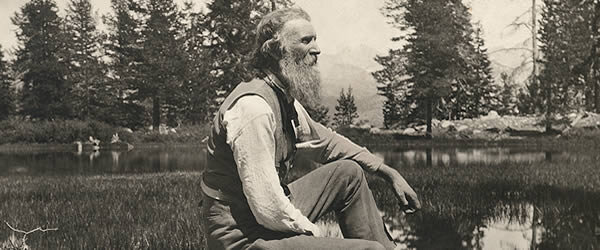
John Muir
John Muir (1838-1914) was the son of a Presbyterian minister. He was born in Scotland and came to the United States in 1849 where they settled in Wisconsin. This, of course, was a time of great upheaval in the country. A civil war was brewing and later fought, the industrial revolution was underway and would dominate American life to create land barons and tycoons, and the land was viewed as something to “tame” - and not to preserve.
John could have easily jumped into the manufacturing careers of the time as he was talented and smart. But, he felt the calling to wander - to explore - to sketch what he observed - and to write about it. His writings were noticed by the magazines of the time and published. John considered his transformation as an advocate for preserving the environment as an “unconditional surrender to nature”.
You can read more about John Muir HERE.
Teddy

Teddy Roosevelt
Theodore (Teddy) Roosevelt (1858-1919) was born to a wealthy, connected family in New York. He suffered from various childhood ailments that kept him home, inside for much of the time. He, however, was very interested in nature so, even as a kid, he studied taxidermy so he could preserve and study animal specimens. He would donate his work to museums so others could learn also.

Teddy and John at Yosemite (Glacier Point)
Teddy overcame his childhood sicknesses by being an advocate of what he called “the strenuous life”. He got outside. He learned to hunt, to ride horses, to herd cattle, to fish, and later, even though he was comfortably set as a public official, he led a cavalry regiment - the Rough Riders - into battle during the Spanish-American War. Teddy became Vice President and then President (the youngest ever) when Pres. William McKinley died. He became a wild, popular, different kind of a president - one who was interested in respecting the beauty and diversity of nature.
You can read more about Teddy Roosevelt HERE.
The Camping Trip
In 1903, President Roosevelt took a three-day camping trip with John Muir to the unspoiled Yosemite Valley. John wanted to persuade Teddy to return this area of the nation to federal protection. He did. Not only did President Roosevelt resolve to protect Yosemite—he would go on to sign into existence 5 more national parks, 18 national monuments, 55 national bird sanctuaries, wildlife refuges, and 150 national forests.

“Roosevelt did more for the national park idea than any other president in history. During a cross-country trip in 1903, he spent three nights camping alone in Yosemite with the other great champion of the parks, mountain prophet John Muir, who enlisted Roosevelt into making Yosemite Valley part of a larger national park. Snow fell on them the night they camped here, near Glacier Point. It was, the outdoorsman president recalled, “the grandest day of my life.””

Sound View Farm: Goats
GOAT: Greatest Of All Time
Next in our tour of the farm animals of Sound View is goats! We currently have 4 goats of 3 different breeds at camp. (They always look silly in photos!)


Where do goats come from?

Wild Bezoar Ibex Photo: Wikipedia
Goats are members of the family Bovidae along with bison, cows, sheep, and antelope. All of these animals have hooves that are split into two toes (cloven-hoof) and are ruminants with a stomach that has four compartments so they digest grasses and other plants. They produce and chew cud just like llamas do. Today’s domestic goats came mainly from a goat called the Wild Bezoar Ibex that is found in Middle East Asia. The goat is thought to be one of the first domesticated animals, with domestication of goats starting around 10 thousand years ago. Now there are over 200 breeds of domestic goat and they exist on every continent except Antartica. Breeds of animals are created when humans select animals for certain qualities. Over time these animals may look pretty different but they are still members of the same species.

Goat yoga Photo: www.seattlenorthcountry.com
Why were goats domesticated?
When goats were first being domesticated, every part of them was used. Today, different breeds have different purposes. Goat milk was the first animal milk that humans used and it remains popular today. Some goats are bred for their fur to make clothing. The most common goat fur products are are cashmere and mohair. Goat skin can also be used to make leather for gloves and boots. In the past, goat skin was used to make something like a water bottle. Some goats are also raised for meat. Goats can be working animals as well. They can be trained to pull carts. Goats are also bred for show and are sometimes kept just for the purpose of being pets. Oh and don’t forget about goat yoga, a trend that started in 2016.
Other goat facts

Females goats are called a “doe” or a “nanny” while male goats are called “bucks” or “billys.” Young goats are called kids. Goats are smart and naturally curious. They are known for escaping pens. They often knock heads with other goats. This can be done in play or to compete for dominance in a herd. If treated and trained correctly they do not do this to humans. Goats are also really good at jumping and climbing. Some can climb trees! Occasionally when domestic oats have escaped or been set free they return to the wild, becoming feral. The can become an invasive species in some areas, posing a treat to native plants. Lastly, goats have rectangular pupils in their eyes instead of round, giving them better peripheral (side) vision.

Sound View Farm: Llamas
Learn about llamas
This is the first in the Sound View Farm series. I though I would start with our fan favorite, llamas.

Bilbo, Sound View’s llama

Guanaco Photo:Wikipedia
Where do llamas come from?
Llamas come from South America. They are in the camelid family and are therefore related to camels. The llama’s ancestors were thought to have been in North America 40 million years ago and migrated to South America 3 million years ago. They were domesticated in the Peruvian Andes 4-5 thousand years ago. Domestication is the process of taming and breeding animals for use as a pet or for having on a farm. There are no true llamas in the wild. They were domesticated from an animal called a Guanaco which still exists in the wild in South America. The Vicuña is another South American camelid that exists in the wild. It is smaller than the Guanaco and is thought to be where Alpacas came from. These animals were and continue to be very important to the people of Peru and surrounding countries. Llamas came to the US in the late 1800’s and were mainly in zoos.
Why were llamas domesticated?
Llamas served many uses for the people who domesticated them and they continue to serve many of these uses today. The one that many people think about is their fur. A llama’s wool is water resistant, lightweight and very warm. It has been used in making clothing, bags, rope, decorations and more for over 6 thousand years and is still used today. Another reason llamas were domesticated is that they can carry packs for long distances. They are the only animal in South America that is able to do so. They can hold somewhere between 25-30% of their own body weight. They can weigh somewhere between 200-400 lbs so may be able to carry around 100lbs. If you give them more than they can carry, however, your llama may just lie down and refuse to move. They are also good on their feet and can navigate difficult mountain terrain. Llamas are also occasionally used for meat. Their poop makes great fertilizer and can be used a fire fuel when dried. Llamas are also very smart and today they are often used to help protect other animals on a farm.

Modern Pack Llama Photo: www.jnkllamas.com

Photo: www.shagbarkridge.com
Llama spit?
Yes, llamas do spit when they are annoyed but they will use their body language before they resort to spitting. If a llama does not want to be bothered it will simply put its ears back and walk away. If they are more agitated, they may raise their head or stomp a foot. Spitting is mainly used toward other llamas because it is more about the social hierarchy in a herd. Llamas will also often regurgitate their food, chew it, and re-swallow it. This is because they have a stomach with 3 compartments and the cud that they regurgitate needs to be broken up before it can be digested more. This way of digesting helps llamas get as much nutrients as possible out of the plants that they eat. If a llama is really annoyed it can spit some digested food from one of its stomach compartments. So, be respectful of the llama’s body language!
Why Knot? - #3 - Synthetic Rope
Learn about the advantages (and concerns) of synthetic (people-made) rope.

Climbing Rope
Most of the rope you will buy in the store now is synthetic. The invention of plastic and other polymers truly changed the world in may ways but, however, with a cost. Synthetic materials do not break down over time. For this reason, we should always be committed to recycling and re-purposing and working to keep synthetic products from ending up in the oceans. As rope is heavily used in the maritime industry, this is doubly important.
Synthetic rope is more durable than natural rope. It can be manufactured in many ways to alter what it is used for. It can have a lot of stretch or just a little stretch. It can float or sink. It can be produced in any color. It can be any size from thin fishing line all the way up to the monstrous mooring lines (hawsers) found on ships.

Spool of Nylon Rope
NYLON
Nylon rope is known for its elasticity and ability to absorb tremendous shock loads. this rope will not rot and is resistant to oil, gasoline, and most chemicals. Along with having good abrasion resistance, nylon rope also has good resistance to UV rays. Nylon rope is used for all sorts of things and you will find it on boats and ships of all sizes. Nylon rope sinks.
The ropes on the Sound View challenge course are made of nylon. There is a woven sheath as well as a tightly woven core which gives it strength. Some of the ropes stretch very little while others, such as on the Big Jum, stretch a lot to absorb the energy of a falling (or leaping) participant.
Fishing line is usually made of a single strand of nylon.

Spool of Polypropylene Rope
POLYPROPYLENE
Polypropylene is a lightweight rope that does not absorb water. It is resistant to oils, mold, mildew, and most chemicals. As such, polypropylene is an ideal rope for certain marine applications. For example, because this rope floats in water, it is often used to create swimming lanes. and ski rope. A lot of general-purpose rope is also partly made of polypropylene.

The At Home Naturalist: Nature Journaling
Start a nature journal!
Last post I talked about how you can get involved in nature and even help with scientific research through the use of technology. I know that using technology is not for everyone especially when it comes to enjoying time in nature. Taking a walk or spending time in your backyard is also a great time to “unplug” and enjoy your surroundings. Through this post I will share some tips to get you started with another great way to be a naturalist at home: nature journaling.

Audubon picture of a Barred Owl Photo: www.audubon.org
The great thing about nature journaling is it can look however you want it to. You can fill it with sketches, painting, poetry, stories, etc. You also can be more scientific, documenting your observations on appearance and behavior, as well as taking measurements. Fill your journal with some combination writings, drawings, photography (this one does require a little technology though). If you don’t mind the use of a little technology, you could also make a video journal. You can also push yourself to work on a new skill or improve an old one.
Nature journaling in some form is at the heart of what it means to be a naturalist. A naturalist is a person who studies and shares about the natural world around us. Some famous naturalists include: John James Audubon who documented many species of birds including discovering new ones through his paintings, Charles Darwin whose observations and journaling led to ideas on natural selection, Rachel Carson who wrote articles and books to teach people about natural history and warned of the effect pesticides have the environment, and David Attenborough who writes and narrates documentaries that helps bring nature around the world to our televisions. All naturalists have a way of documenting and sharing their knowledge and observations with others.
Starting your Nature Journal

Like I have been saying, there are numerous ways to make a nature journal but a great way to start is to start practicing your observation skills. To start practicing this, what you will need is some paper, a writing utensil and a simple nature object like a rock, stick, leaf, or flower. Remember not to pick anything off of living plants. Sit somewhere comfortable where you can look at this object for a while. Start using your senses to make observations about your object. Write these down. You can also draw your object and label the observations you are making. What is the shape? Colors? Textures? What does it smell like? What sound does it make? Even if it feels like a silly observation, write it down. Once you have observed all that you can, look for more maybe from a different angle. Then spend some time writing down questions you have about it, even if they are silly. You can also write things that the object reminds you of.
The next time you journal, try a new object or maybe do this for a bird in your yard or an invertebrate you find under a log. It is important to keep going even if you feel silly because the more you practice, you will become more observant. Through this, you can learn a lot about the natural world around you. You also do not need to know the names of things or what even they are, just focus on using your senses. You can share your findings with your friends and family or keep them to yourself.
Other important things you can include in each journal entry include: the date, time, exact location, and weather.
You can also add some nature related poetry, art, leaf rubbings, printed photos. Don’t worry about any of your work being “good.” What really matters is that your journal connects you with nature and you gain some new observations or knowledge from doing so. Just remember to leave no trace and leave nature as you found it!
John Muir Laws, a fantastic naturalist and nature journaling expert, has some great resources, tips and drawing lessons on his website: https://johnmuirlaws.com/

The At Home Naturalist: Citizen Science
Looking for new ways to learn about and interact with the natural world around your neighborhood?

Photo: citizenscience.org
If you are looking for new ways to interact with the nature around your home, there are some fantastic options to not only learn about what is around you but also to help contribute to scientific research. There are a number of apps and websites that use the help of people just like you to make observations (often through pictures you can take on your phone). In doing this you can participate in what is called citizen science, where the public helps research scientists collect data. I like to think that the “citizen” part of this means all people on Earth no matter their background, experience, or education because we all can help scientists learn about the amazing world we live in. This is also a great way to virtually get involved for the 50th anniversary of Earth Day which is on Wednesday of next week (April 22nd)!
There are so many citizen science options out there. They are definitely not limited to the few I am about to mention below. So if there is a topic you are interested in that doesn’t get covered in this post, I highly recommend doing your own research into it! You can start here: https://www.citizenscience.org/out-of-school/
iNaturalist
My most used citizen science app it called iNaturalist. I enjoy taking pictures of nature so it is an easy extra step for me to post these pictures on this app/ website. After I upload the picture, I can give my best identification of what I found. Then, others in the iNaturalist community can either agree or disagree with my identification of the organism. If the photo gets enough positive identifications, it becomes “research grade.” iNaturalist has had so many observations that they are now able to use image recognition technology to identify what you are looking at. I was just introduce to their new app called Seek. This app identifies the organism you are looking at to the best of it’s ability. Then when you take the picture, it gives you information about what you are looking at as well as the option to post it to iNaturalist (if you have an account). You do not need to have an account to use Seek. You can simply use it to learn about the plants and animals in your neighborhood! You also earn badges on the Seek app for identifying organisms.
Here is the iNaturalist home page: https://www.inaturalist.org
Here is information about Seek: https://www.inaturalist.org/pages/seek_app
Here is what Seek looks like. It was able to identify this plant to species: Big Leaf Maple!


Merlin Bird ID and eBird

American Crow
If birding is more of your interest, an excellent way to start or increase your knowledge of the birds you see is through the app Merlin Bird ID. This is also an app that I have been using for a long time. It is by the Cornell Lab of Ornithology. Ornithology is the study of birds. When you download the app, you also download a “Bird Pack” for your area. I have the US: West Coast Pack on my app. Then you can either identify a bid through a photo or by description. The description option will ask for location, date, size, main colors, and a little about the behavior of the bird (was is in the water, in the bushes, on the ground etc). It will then list some possible birds. From here you can learn about the bird and listen to that calls it makes. Once you feel like you have learned many of the birds in your area, you can join the eBird project. This is a separate app that you can link to your Merlin Bird ID. In eBird you can “start a check list.” This will start a timer and bring up a checklist of birds. You can search for the bid you see and add how many individuals of that species you find. This can be done on a walk around your neighborhood or while siting in your backyard. It also can be done from a computer. If you do ID birds in your yard, you can add the “Yard tool” to keep track of what kind of birds you see in your yard all year round. Check this out for more info: https://ebird.org/news/discover-the-birds-in-your-yard-or-garden . You do need some comfort with the species of birds in your area.
Here is more about Merlin Bird ID: https://merlin.allaboutbirds.org/
Here is more about eBird: https://ebird.org/about
Globe at Night

Big Dipper in the Ursa Major Constellation
If the night sky is more in your interest, Globe At Night is a great option. It collects data about how well you can see constellations in the night sky during select times of the year. The next data collection time is going on no through April 24th. You will be looking for the constellation Leo. The reports asks you for your location, date, time of observation, how many stars you can see, and what the weather is. The purpose of this project is to document and raise awareness about light pollution. Light pollution is caused by all of the lights that are on at night in building and on the streets. Not only does this affect our ability to view the sky, it can affect many animals as well as raise awareness about how much energy we use to keep those lights on. I know we don’t get too many clear nights in Washington, but that is important information as well! If you are unsure of how to find Leo, the website can help you with that too. There are also some great star finding apps including Sky Map and SkyView Lite.
Here is more information about Globe at Night: https://www.globeatnight.org/5-steps.php
In other news, if you are located around the South Sound and are interested in some virtual Earth Day events, check out https://earthdaysouthsound.org/ . For those located in other areas, check out: https://www.earthday.org/ .
If using technology is not the way you want to interact with nature, tomorrow I will share how to be an “At Home Naturalist” without the use of technology!

Relationships in Nature
How do different organisms interact in nature

Lichen
One of my favorite things about the natural world is how everything works together to balance each other out. The different types of interactions between living things come with different names based on how each organism involved is affected. Some interactions are necessary for an organisms survival, some hurt an organism involved, an some happen without an organism even knowing it. I have mentioned a few of these relationships before in yesterday’s post about flowers: http://www.soundviewcamp.com/nature-blog/2020/4/14/flowers-of-sound-view and in a post about lichen: soundviewcamp.com/nature-blog/2020/3/30/lichen
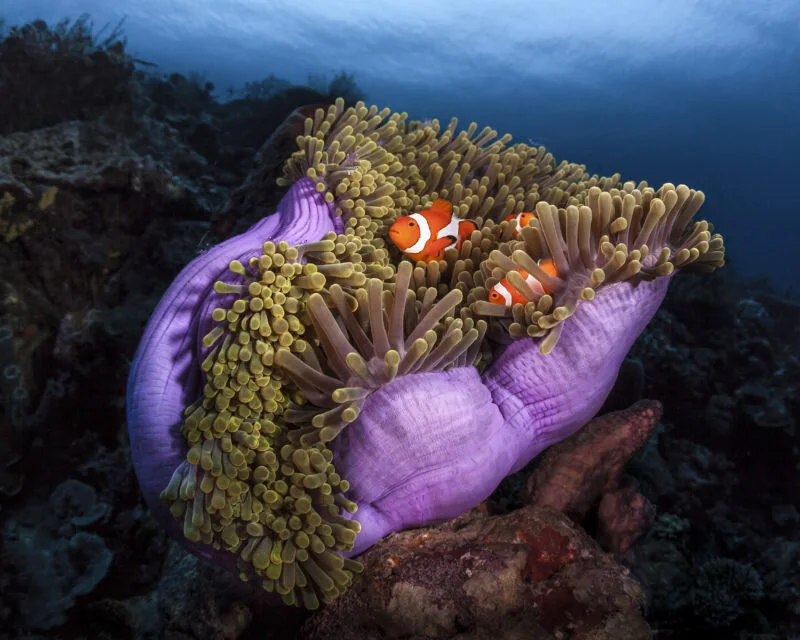
Photo: Scubadiverlife.com
Both in the case of the flower/pollinator relationship and in the lichen relationship between algae and fungi both organisms benefit from their interactions. This is called mutualism. There are many ways and reasons that mutulism happens. In these relationships the benefit gained by either organism involved is food, protection, or dispersal of pollen/seeds. It can also be a combination. For example, a pollinator gets food from a flower and then helps disperse pollen from the flower to other plants. Also, a mutualistic relationship may be necessary in order for each organism to survive, like in lichen. This is called obligate mutualism. However, if it is facultative mutualism, both organisms can survive without each other but do better when they have the interaction. A famous example of mutualism that I haven’t mentioned yet is the relationship between clownfish and anemones in tropical water. The clownfish brings food to the anemone and in return the anemone’s stinging cells offer good protection against predators for the clownfish. Both can survive without each other. The anemone will get enough food and the clownfish can find another hiding spot to live. Together though, they help increase each other’s chance of survival.

Headbutting in Elk is an example of competition. Photo:http://maplehurstelkfarm.weebly.com
Other types of relationships between organisms are where one benefits but it hurts or kills the other organism in return. One example of this is the predator/prey interaction. The predator, such as an Orca, hunts and kills the prey, such as a salmon. In this case the Orca benefits with food that will give it energy, but the salmon is no longer living. While it is sad for the salmon, this interaction helps keep populations of animals healthy because a predator is more likely to catch a sick, injured, or old prey, leaving the healthy ones to reproduce and continue their species. Another relationship where one benefits and the other doesn’t is called competition this can happen with in a species or across species. Organisms may compete for food, sunlight, space (territory), mates. In the case of competition, one individual “wins” and gets the resource while the other is left without it or must use more energy to find it elsewhere. Lastly parasitism, is where one organism (parasite) lives in/on another (host). The parasite gains food from its host and the host is hurt by the parasite to some extent. Ticks are an example of a parasite.
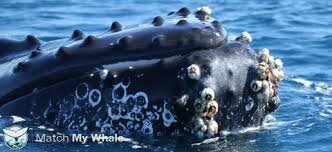
Whale Barnacles Photo: https://www.matchmywhale.org
There are also relationships where one is unaffected and the other either benefits or is harmed by the interaction. If one benefits and the other is not affected, it is called commensalism. An example of this is the barnacles that attach to whales. The barnacles get a free ride across the ocean, increasing their access to food. These barnacles are not parasites because the do not hurt the whales. If the organism affected is harmed, this is called amensalism. An example of this is cows trampling on the grass. The grass is crushed while there is no effect on the cows.

Flowers of Sound View
See some of the flowers that are blooming around camp
Flowers are in bloom all around camp right now. They are not only beautiful, they also are an important part of the plant. Flowers help plants reproduce. They often are brightly colored and produce a scent to attract pollinators such as bees and butterflies. These pollinators and the plants producing the flowers have a mutualistic relationship. Both the plant and the pollinator benefit from the relationship. The pollinator gets nectar from the flower and in turn (without knowing it) the pollinator spreads pollen to other plants. When a flower has been pollinated it can then turn into seeds that will grow more plants. Different plants have different ways of dispersing their seeds. Some enclose their seeds in sweet and tasty fruit, relying on animals to eat them and drop the seeds somewhere new. Some have seeds that get carried by the wind, like dandelions and maples. Some have seed that stick to an animals fur or in your socks.
Here are some flowers around Sound View right now:


Why Knot? - #2 - Natural Rope
The next in our knot series
Natural rope has been made from all sorts of plant byproducts. Anything that produces fibers van be twisted into yarn and then twisted again into rope. Here are some examples:
Cotton Rope is a lightweight soft 3-strand rope that is often used for decorative purposes. Cotton rope is very stretchy and is extremely comfortable to handle. It can also be easily dyed. Cotton ropes are used for sash cord, clothesline, and Venetian blind cords
Manila rope is a type of rope made from manila hemp. Manila hemp is a type of fiber obtained from the leaves of the abacá. The name refers to the capital of the Philippines, one of the main producers of abacá. Applications and properties Manila rope is very durable, flexible, and resistant to salt water damage, allowing its use in rope, hawsers, ships' lines, and fishing nets. It can be used to make handcrafts like bags, carpets, clothing, furniture, and hangings.
Sisal is a species of Agave native to southern Mexico but widely cultivated and naturalized in many other countries. It yields a stiff fiber used in making various products. Sisal rope is a hard natural fiber with many characteristics of manila rope but offers 80% of its strength. Sisal is more economical than manila. It has a good knot-holding ability. It provides great knot holding ability and is sunlight resistant.
White coir, harvested from unripe coconuts, is used for making finer brushes, string, rope and fishing nets.[2] Coir rope has the advantage of not sinking, so it can be used in long lengths on deep water without the added weight dragging down boats and buoys.


All these natural ropes will deteriorate over time. This may seem unfair and expensive for the human that owns the rope or fishing net, but if a fishing net is lost, it will entangle sea life for years - but even longer if it never rotted naturally or could be consumed by other sea life.
Why Knot? - #1 - Rope? or Line?
A rope is named for its purpose.
Rope making surely changed the world. The ability to pull (instead of push), to secure, to weave, to stitch and to harness animals depended on rope of carious sizes and make. Historians have no idea when people started twisting fiber into yarn and then yarn into rope. Because rope was made with natural fiber, remnants would rot away and disappear long before archaeologists could discover them.

A spool of rope.
Sailors like to put names to things. Imagine being on a sailing ship long ago and someone yells, “Pull in the the rope ! “ What rope? There is rope everywhere tied to everything imaginable!
Rope, on a ship especially, is given a name to designate its purpose. At Sound View, you will find useful rope at the waterfront, on the flagpole, and also at the rope course. Each piece has been cut for a specific purpose.
ROPE - what you buy at a store, or what is in storage on a spool. Rope has not been cut for a purpose yet.
LINE - a length of rope that has been cut for a purpose.
HALYARD - a line that pulls up something - like a sail - or a flag.
SHEET - a line that pulls in a sail.
PAINTER - a line that is attached to the bow or stern (front/back) of a small boat to tie it up.
STAY - a line that holds up a mast . One end is attached to the top of the mast and the other end is attached to the bow or stern.

Dinghies tied up with their painters
STAY - another line that holds up a mast . One end is attached to the top of the mast and the other end is attached to the side of the boat.
HEAVING LINE - a small line to throw to another boat, or onto a pier, or to a person in the water.
MOORING LINE - used on larger boats to tie up.
RODE - line and/or chain that attaches the anchor to the boat.
BELAY LINE - the line used on the ropes course to secure the climber to a safety system on the ground.
LOBSTER CLAWS - a short line rigged with various knots and carabiners to create a personal safety system for climbing.

Types of Rocks
This post rocks!
We see them everyday though we often don’t pay too much attention to them until one gets stuck in your shoe. However, rocks can hold information on an area’s past, they contain minerals important for life and they form beautiful landscapes around us.
All rocks are made up of minerals. Minerals are made of a single substance and are formed in orderly and predictable patterns. For example, the mineral quartz is made up of Silicon and Oxygen (SiO₂) and forms a specific crystal structure. Rocks are combinations of minerals that are stuck or fused together by a process that involved intense heat and/or pressure. Geologists, scientists who study rocks, separate rocks into three categories based on how the rock was formed: Sedimentary, Igneous, and Metamorphic.
Sedimentary
Sedimentary rocks are formed from the layering of smaller particles such as sand, silt, clay etc. As these particles build up, the weight of them pushes down on the layers below. This pressure forms the rock. For example, when sand is compressed it forms Sandstone and silt forms Siltstone. Animal and plant remains can be trapped in the layers as well, creating fossils. You can only find fossils in sedimentary rocks because it is the only one that is formed without intense heat. Also, a type of sedimentary rock called limestone is formed from the calcium shells of past seashells and plankton.


Igneous
Igneous rocks are formed when magma or lava cools. Rocks formed from magma underneath the surface of the Earth are Intrusive Igneous while ones that forms from lava on the surface of the Earth are called Extrusive Igneous. Magma cools very slowly underground. This causes the Intrusive Igneous rocks to have large mineral crystals in it. An example of this is Granite where you can see the clear-ish quartz, the shiny black mica, and the white to pink feldspar. Lava cools much quicker on Earth’s surface either because of the air or water. Examples of Extrusive Igneous are the light Pumice, black Basalt, and the shiny Obsidian. How quickly the lava cools as well as the chemical make up of the lava play a huge role in what type of rock it becomes.


Metamorphic
Metamorphic rocks form under large amounts of heat and pressure and/or chemical processes. They form from Sedimentary or Igneous rocks that go through changes in structure and composition because of these things. This transformation mostly happens deep underground where the shifting of the Earth or the heat from magma causes the changes to happen. Some metamorphic rocks have a layered appearance (lines of mineral through them), such as Gneiss (pronounced like “nice”). This forms because the minerals melt and re-crystallize. An example of a metamorphic rock that does not appear layered is Marble. It is formed when limestone undergoes extreme heat and pressure.


All photos are from Geology.com. It is also a great resource if you want to learn more and see more examples of these rocks!
In summary, Sedimentary rocks form through layering of material. Igneous forms from the cooling of magma and lava. Finally, Metamorphic rocks are formed when another rock is put through heat and pressure that changes it’s structure.

Watersheds
What is a watershed?
Photo: 123RF.com
Imagine being a raindrop. You have landed on the side of a mountain with many other raindrops. As it continues to rain, you and the other raindrops start moving down the mountain. Some of the water sinks into the ground, some gets stuck in puddles that will later evaporate and return to the sky. As you continue down, you meet up with even more raindrops in a little stream. This stream flows quickly down the mountain side and eventually you enter a river. A lot of the water you meet here is from the snow melting at the top of the mountain. You continue in this river for a long time. Sometimes you travel quickly and other times are slow and winding. Again, some water drops evaporate, others sink into the ground and some are even taken by animals as they drink from the river. Eventually, you end up in a larger body of water such as a lake, ocean or the Puget Sound. You started off as raindrop and ended up traveling through the whole watershed. The water you traveled with all came from different locations but mostly all ended up in that big body of water.

Mississippi River Watershed Photo:nationalgeographic.org
A watershed is an area of land where all of the water will drain into one location such as a large river, lake, or ocean. Watersheds can range from being small to very large. The small watersheds, such as the area of land that drains into a creek by your house, can also be part of larger ones. The largest watershed in the US is the Mississippi River Watershed which includes 31 states and 2 Canadian Provinces. It drains into the Gulf of Mexico. This means the those 31 states and 2 provinces affect the water quality of not only the Mississippi River but also the Gulf of Mexico and eventually the Atlantic Ocean.
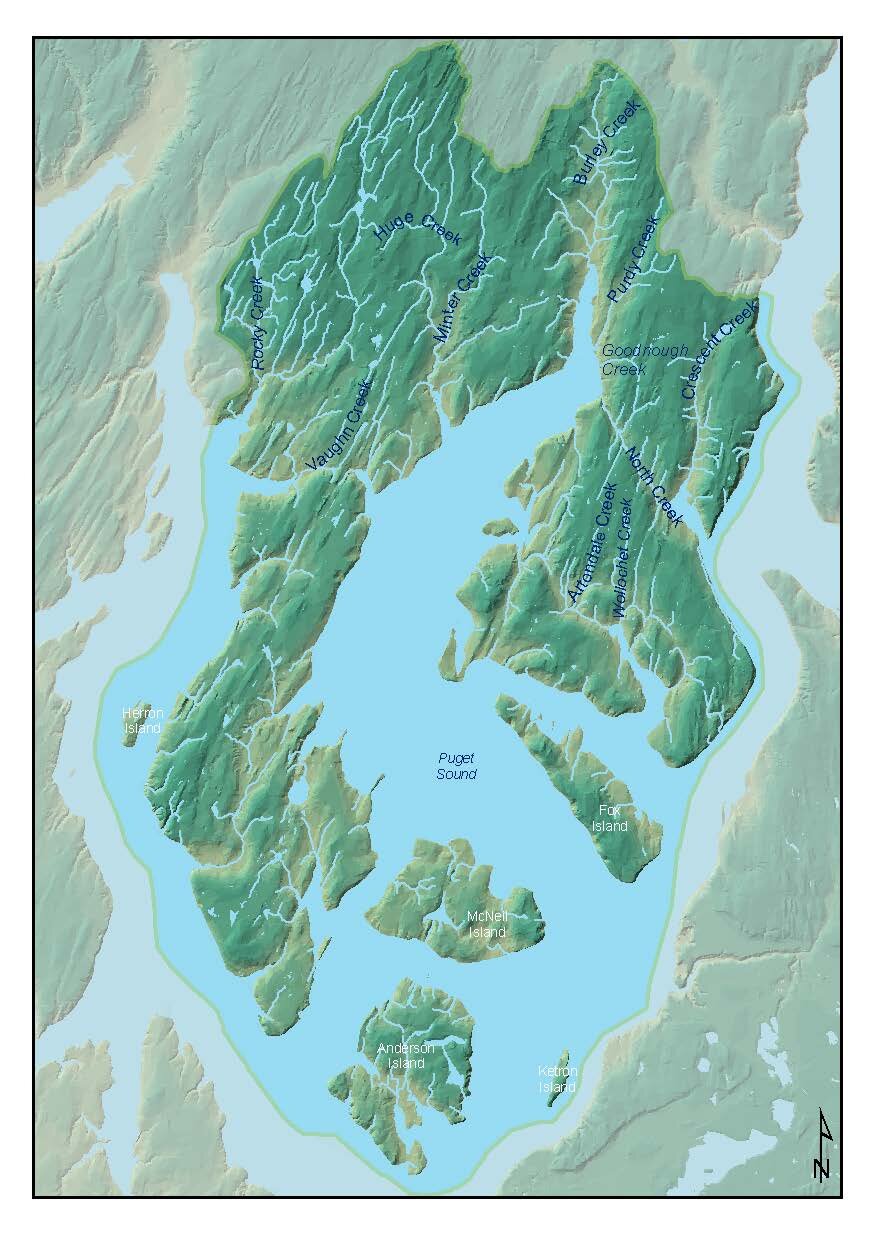
KGI Watershed
Photo: https://www.piercecountywa.org/1864/Key-Pen---GH---Islands-Watershed-Council
To bring this idea a little closer to home, camp is on the Key Penninsula-Gig Harbor-Islands (KGI) Watershed. All of the land in this area drains to creeks and streams that then drain to the Puget Sound. The Puget Sound is then connected to the Pacific Ocean.
Not all of the water that hits the ground in a rainstorm will end up making the full journey through the watershed. Some of it will evaporate back into the air. Some will sink underground and be taken up by plants or go into underground water storage called an aquifer. Also, some water will be used by animals and people. Watersheds are important because they supply water to all of these places. This is also why it is important to keep our watersheds healthy.
Think back to being a raindrop. Maybe on your journey down the mountain, you pass some litter that is pushed by the water around you into the stream, then the river, and eventually into the ocean. That litter makes the same long journey you do as a raindrop. Pollution in the watershed happens in one of two ways: Point Source Pollution and Non-Point Source Pollution. Non-Point Source Pollution would be like the litter that was carried down the mountain with you because while you were carrying that litter, so were many other raindrops in many other points of the watershed. We would not be able to tell exactly where that pollution came from. Another common Non-Point Source Pollution is oil that is washed off streets an into the waterways. Point Source Pollution can be traced to a single location. For Example, if you were kayaking in the Puget Sound and all of the sudden you say a lot of Sound View Camp stickers floating on the water, you would know exactly where those stickers came from. A more real-life example might be a sewage leak from a single pipe or chemical leak from a factory.
No-matter what the pollution is, it will affect the rest of the watershed downstream from where it started. This means pollution can ad up quickly. However it is also something we can fix! By picking up trash, telling an adult about a leak/spill, and using your resources wisely, you can help protect a whole watershed!
Try at Home:
Here is a short activity you can do to learn about watersheds:
What you will need is a piece of printer paper (it only needs one side to be blank), washable markers, water (in a spray bottle works best but any way you can drop it on to the paper is fine)

Steps:
Crumple up your paper into a ball
Carefully unfold it so that the crinkles are still raised (don’t smooth it out.)
Trace the “ridge lines,” or where the paper is raised. Thick washable marker lines work best.
Spray (or drip) water onto the paper
Watch the water and the color run down your paper mountains. Where is the water all going to? Where does it all collect? Do you have more than one watershed on your paper?
You can try this again and this time add some random dots of a different color to represent pollution. Observe where the pollution goes and how it adds up.
Make sure to dispose of your project properly.

Fire Building
Learn how to safely build a fire

Building a fire can serve many purposes. It is good for cooking, providing warmth, and for sitting around with friends and family singing and telling stories. I also find building a fire can be a rewarding and relaxing experience. If you are thinking about making a fire, you first have to follow some steps to make sure you do so responsibly because as fun as it is to have a fire going, it can also be dangerous if not done properly.
Check with the local fire authorities to make sure burning is allowed. This is especially important for outdoor fires. Also, check that is it not going to be a windy day so sparks do not fly far. (For folks on the Key Penninsula, check here: https://www.keypeninsulafire.org/)
Check with your supervising adult to make sure they will be able to help you watch the fire.
Make sure you are following Leave No Trace Principle #5 to Minimize Campfire Impacts: Make sure you start the fire in a safe designated ring or pit, keep the fire small, burn the wood until it is all coals and ash, make sure the fire is all the way out when finished
Wear proper clothing without anything dangling (like jacket strings) and pull long hair back. Closed toes shoes should always be worn around an outside fire.
Make sure at least a bucket of water is in quick access for if your fire becomes larger than you want.


Once you have done all five of these things, you can start gathering what you need to start your fire. Fires need three things to start: Oxygen, Fuel, and a source of Heat (such as a spark or fire from a match). The great thing about this is you can practice your fire building techniques without actually starting a fire if you leave out the source of heat and just practice with the fuel, setting it up to make sure it would have a good flow of oxygen.
For the fuel you will need to gather three types: Tinder (not the app), Kindling, and Fuel Logs. All of this fuel must by dry and safe to burn. I like to remember the sizes of tinder and kindling by saying “tiny tinder” and “kid-sided kindling”. The tiny tinder are small sticks no thicker than a pencil tip and about the size of your hand. This is what you want to catch first and then light your kindling. Fire starters also count as tinder. Paper can be used as well, however paper creates more flying ashes which can be dangerous. It is always best to have more tinder than you think you will need.
Kid-size kindling should be about the thickness of your thumb and about the length of your finger tip to elbow. The job of kindling is to light the fuel logs so you will want a lot of this so you can keep feeding it to the fire until the logs catch.
Lastly are the fuel logs. If you plan to just practice your fire building skills and you do not want to keep the fire going for a long time, you do not need these. However, if you are setting a fire to keep it going for heat or cooking you will want logs that will keep burning for a while. The size of you logs will depend on the space you have for your fire and what your goal is for the fire.
Once you have all of your materials, you can start building. Start with a clear fire ring, free of most ashes from previous fires. Then put a small, loose pile of your tinder. Around this pile you can set your kindling. There are many shapes that work to start a fire. Remember to leave space for good airflow, as oxygen is one of the key ingredients for the fire. My favorite shape is the “A-frame” which looks just like a capital “A” with the pile of tinder in the middle. Other options are a “Teepee,” a “Log Cabin,” or a “Lean to.” Below are pictures of each type. I demonstrated them with logs but you can start these shapes with the kindling. Try them all! This is something you can try without even lighting a fire.


Once you have your structure set, you can add the heat. There are many ways to do this as well: Flint and steel, wooden matches, gas match/long lighter, etc. Make sure an adult is supervising you for this step! Once your fire is lit, keep carefully adding tinder until the kindling catches. Then keep adding kindling until the logs catch. Make sure to keep allowing airflow to the fire so it gets the oxygen it needs. You can carefully blow on the fire to add airflow. When you do this, blow at the base of the fire gently so you don’t blow it out. Watch the fire the whole time it is burning.
When it is time to put your fire out, add water to it. This cools the fire and blocks the oxygen from the fuel. Make sure your fire is all the way out before leaving the area. Ask an adult how they would like you to clean up after the fire is out. This might involve returning any unused wood fuel and cleaning up the ashes once the are fully cool.