Pacific Madrona
Most evergreen trees tend to be conifers, like the Douglas Fir and the Western Red Cedar. They keep their small, needle-like leaves all year round. Trees with broader leaves, like a Big Leaf Maple, are known for losing their leaves in the fall to conserve energy when there is less sunlight. We often use the term deciduous to describe trees that drop their leaves. The broad-leafed Pacific Madrona (Arbutus menziesii) is an exception to this as it is a broad-leaf tree that is also evergreen.
The Pacific Madrona often stands out among other trees in the forest because of its bright red, smooth bark. As the tree grows, the bark peels off, revealing the younger green bark underneath. This also helps stop any fungus or parasites that might be growing on the tree. The name Madrona comes from Spanish madroño, meaning strawberry tree, because the berries of the Madrona and it’s Mediterranean relative look a bit like strawberries. The berries are not often eaten by people but are a great food source for many birds.
Madronas are also known for their curvy branches. As you look up at a Madrona, you may even see that the main trunk is growing in an odd direction. They grow in the direction that will get them the most sun. It is a great way to survive in a forest full of big conifers.
Next time you find a Madrona, try touching the trunk. You may notice that is feels a little cooler than the other trees. Even though Madronas are the same temperature than other trees, they feel colder because of their thin bark.


Banana Slug
Slug+Slime=Success

Here is a post about another big Mollusk. Mollusks are a group of animals that have no backbone (invertebrate), have soft bodies, and often have some type of shell. Snails, clams, octopus, oysters and slugs are some examples of Mollusks.
Banana Slugs (Ariolimax columbianus) are North America’s largest slug, reaching up to 9 inches long. They are named for the color of their body which can vary from bright yellow to brown. Some even look like a bruised banana, yellow with brown spots. You can find them in wet, cool forests from the central coast of California all the way up to Alaska. If you are on the hunt for a Banana Slug in your backyard or a local park, look in moist areas, under leaves, and by fallen logs. (Just make sure you leave no trace!)
Banana slugs cover their body in slime to help prevent them from drying out. They also use the slime to help them move, stick to things, and even to communicate with other slugs. When a predator, such as a Garter Snake, decides to have a Banana Slug for lunch, they are in for a mouthful of slime that causes their mouth to go numb!
Like the Moon Snails we learned about a few days ago, Banana Slugs have a radula. Instead of using it to drill holes in clams, Banana Slugs use their radula to munch up fallen leaves and other parts of plants. They help turn it into soil so more plants can grow. Do you know what animals are called when they eat dead plants and turn those plants into soil? Answer the bonus question at the end of the quiz!

Difference Between Seals and Sea Lions
Learn more about the difference between seals and sea lions.
This is a great article borrowed from the National Ocean Service

Have you ever wondered about the main differences between seals and their "second cousins," the sea lions?
Both seals and sea lions, together with the walrus, are pinnipeds, which means "fin footed" in Latin.
But seals' furry, generally stubby front feet — thinly webbed flippers, actually, with a claw on each small toe — seem petite in comparison to the mostly skin-covered, elongated fore flippers that sea lions possess.
Secondly, sea lions have small flaps for outer ears. The "earless" or "true" seals lack external ears altogether. You have to get very close to see the tiny holes on the sides of a seal’s sleek head.
Third, sea lions are noisy. Seals are quieter, vocalizing via soft grunts.
Fourth, while both species spend time both in and out of the water, seals are better adapted to live in the water than on land. Though their bodies can appear chubby, seals are generally smaller and more aquadynamic than sea lions. At the same time, their hind flippers angle backward and don't rotate. This makes them fast in the water but basic belly crawlers on terra firma.
Sea lions, on the other hand, are able to "walk" on land by rotating their hind flippers forward and underneath their big bodies. This is why they are more likely to be employed in aquaria and marine shows.

Sea Lions on Buoy #2 off of Sound View Camp
Finally, seals are less social than their sea-lion cousins. They spend more time in the water than sea lions do and often lead solitary lives in the wild, coming ashore together only once a year to meet and mate.
Sea lions congregate in gregarious groups called herds or rafts that can reach upwards of 1,500 individuals. It's common for scores of them to haul out together and loll about in the sand, comprising an amorphous pile in the noonday sun.
TAKE THE QUIZ
The Parts of a Canoe
Look at the picture of a typical canoe and figure out the parts.
Do you know the parts of a canoe? Study this picture and see if you can answer the questions.

TAKE THE QUIZ
Wearing a PFD
PFDs keep you safe when out on the water. Discover more!

A cork PFD from the late 1800s
Whether you come to Sound View for outdoor education, summer camp, with a group, or with your family - BEFORE YOU GET INTO A BOAT - you will have to put on a PFD.
PFD stands for Personal Flotation Device. But, it has many other names such as life jackets, life vests, life preservers, or Mae Wests.
Long ago, sailors fashioned PFDs out of wood (cork especially) or used the inflated bladders of animals to keep afloat. Later, “kapok”, made out of vegetable matter in water-tight was used but later, this was replaced by synthetic foam and more modern inflatable vests.
Before putting on a PFD, make sure that it is stamped with a United States Coast Guard (USCG) approval. Use ALL of the straps and zippers on the PFD making sure that they are secure and snug. Make sure that the PFD fits your body size.
Being safe out on the water is really fun - especially at Sound View Camp. WEAR YOUR PFD!
TAKE THE QUIZ
Moonsnail
Moonsnails are the largest snail in the Puget Sound! Learn more about them here.

Young Moonsnail
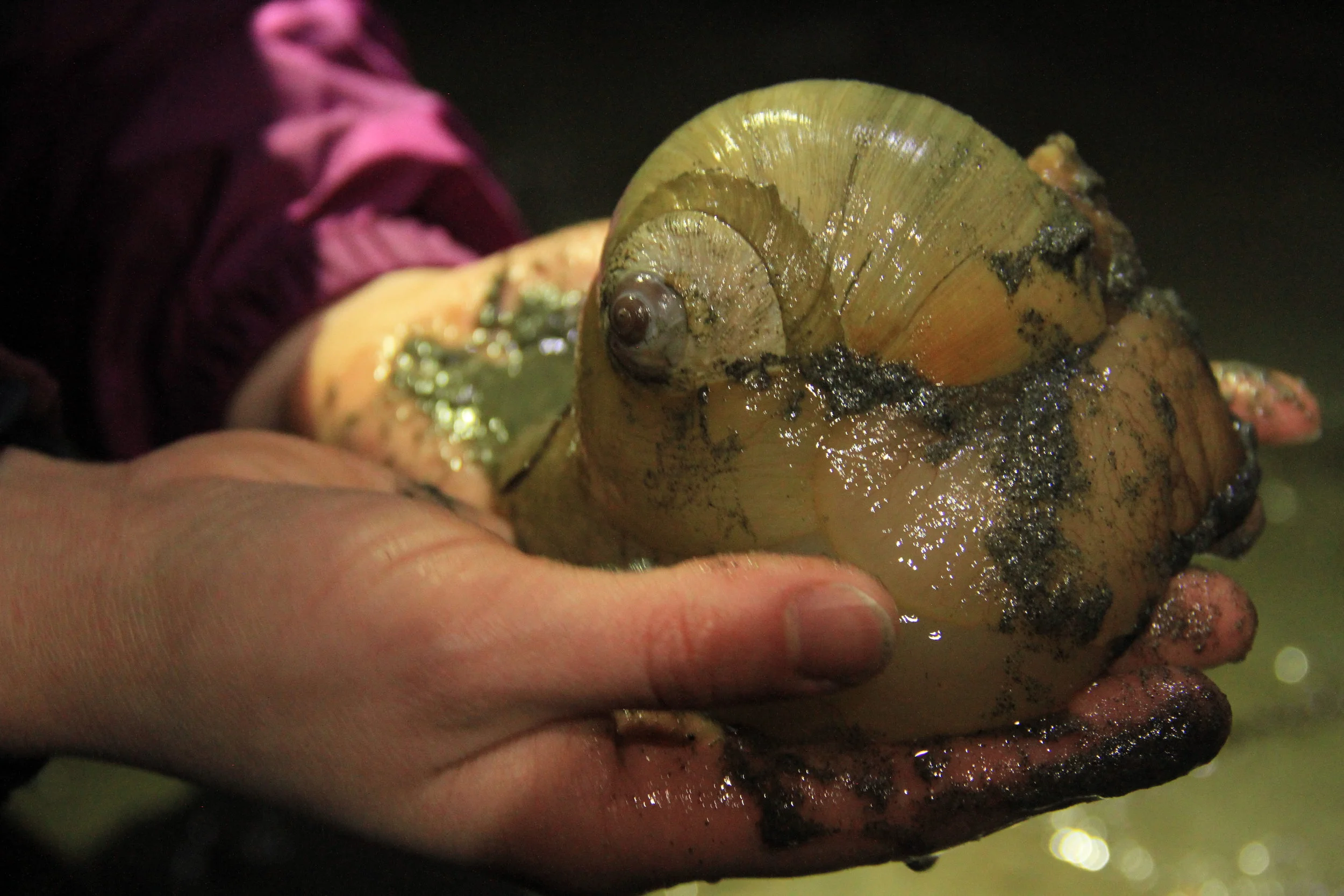
Lewis’s Moonsnail (Euspira lewisii) is the largest snail in the Puget Sound. They were named after Merriweather Lewis after he discovered them at the mouth of the Columbia River. The Moonsnail’s shell can be as large as 5.5 inches with its body length reaching nearly 12 inches when fully extended. The one pictured to the left has a lot more growing to do. If you are lucky you may find a Moonsnail on a sandy beach at low tide. You may dig one up while looking for clams. That Moonsnail was probably looking for clams too! Moonsnails are predators, meaning they eat other animals, and their meal of choice is the clam. Once they have located a clam, they use their rough tongue, called a radula, to drill a hole in the bottom of the clam shell and eat what is inside.
In the spring and summer, you may also find Moonsnail eggs on the beach. At first glace, it may look like a piece of trash. If you look closer, you may notice it looks like the sand from the beach. Moonsnails mix their eggs in with some sand and they use their slime to hold it all together. This forms what is called an egg collar because is looks like an old-fashioned detachable shirt collar. As this egg collar starts to break apart in the waves, the eggs hatch and the young moonsnails are released to spend the first part of their life floating in the water as plankton. When they start making their shell, they will settle on the sea floor.

Moonsnail egg collar
Citizen Science: Winter Beach Monitoring

A group of happy volunteers warming themselves around the fire. Thank you to Paul Cranefield for taking all of the photos!
This past Saturday night, January 19th, was a special day for our budding Environmental Education program here at Sound View. It was our first night of beach monitoring. It was also my birthday (Nancyrose here) and what could be better than the combination of the two?! Thirteen friends came out to help with the beach monitoring, and they were quick learners and happy to spend the night out under the light of an almost-full moon.
This beach monitoring experience is part of an effort to conduct more citizen science at camp. Citizen science is the participation of members of the general public, rather than professional scientists, in scientific inquiry. The goal of citizen science is for people to have fun, learn a lot, and find out more about the world around us. But it’s not just for fun — regular folks can actually make a big impact by doing citizen science, as they help collect meaningful data that may be small on its own, but combined with other scientific data can make a difference. For example, the data from our beach monitoring experience will go to the marine education organization Harbor WildWatch. They will then submit it to a database that collects long-term data on beaches throughout Puget Sound. In the long run, the data we collect from our Sound View beach could give helpful information about the health of Puget Sound — whether populations of certain species are increasing or decreasing over time, whether invasive species have entered into our waterways, and how the numbers of creatures change from month to month, affecting the availability of food for other animals. We will also benefit by learning more about what makes Sound View’s beach special!

A KelP Crab explores underneath the pier. check out those long legs! Pick them up with caution: Their legs are quite sharp on the ends, and can pierce the skin.
Our 100 acres of forest and long beach provide a variety of ecosystems to do some great science. Our bird count on January 5th was an example of citizen science: a snapshot of the birds in an area at a given time. The data from the bird count was submitted to eBird, which is an online database where avid birdwatchers can enter their avian observations so that they can be used for conservation purposes! Bird counts at Sound View will be especially interesting because so many birds migrate through this region.
But enough about birds! Back to marine biology! Here is a collection of the best photos from the night. Together they tell the story of our big night. We can’t wait until our next beach monitoring experience in the summer!


CLICK ON THE ABOVE PICTURE AND YOU’LL BE ABLE TO SEE ALL OF THE PHOTOS FROM BEACH MONITORING!

We first did a presence/absence survey, in which we indicated whether there were any of a certain grouping of creatures in a 3x5 meter area. We did this all the way from the tree line down to the -1 tide line, 81 meters in all!

The second part of our survey was Counting all of the individuals within 2o different quadrats by species. We occasionally used a field guide to consult if we didn’t know a species.

A whelk, a chiton, and a lot of barnacles. We found an abundance of creatures on rocks, not so many in the sand. disruptions, such as pilings, rocks, and fallen logs, are generally places of more ecological diversity.
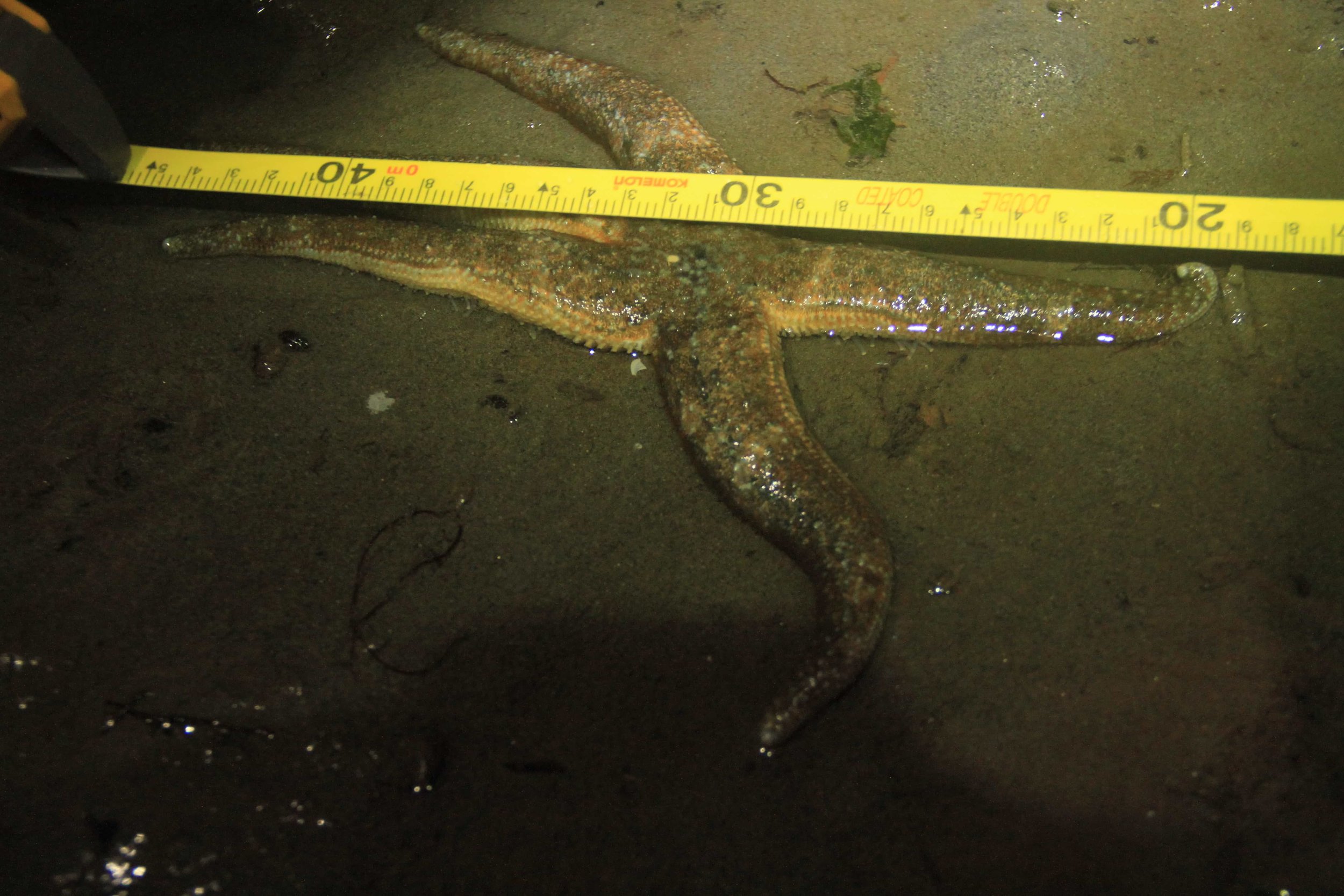
The third and final part of our survey was the sea star count. We walked along the beach for a total of 1o minutes searching for sea stars. For every one we had to measure its radius and check for signs of sea star wasting disease, a disease that has been causing die-outs of sea stars all along the north pacific coast. Unfortunately, this mottled sea star (Evasterias troschelli), the only one we found, seems to have some of the early signs of the disease - white lesions along its top.

We finished so quickly that we even had plenty of free time to explore underneath the pier, which is not within our survey area. This is where we found some of the most interesting creatures!
Winter Bird Count Numbers
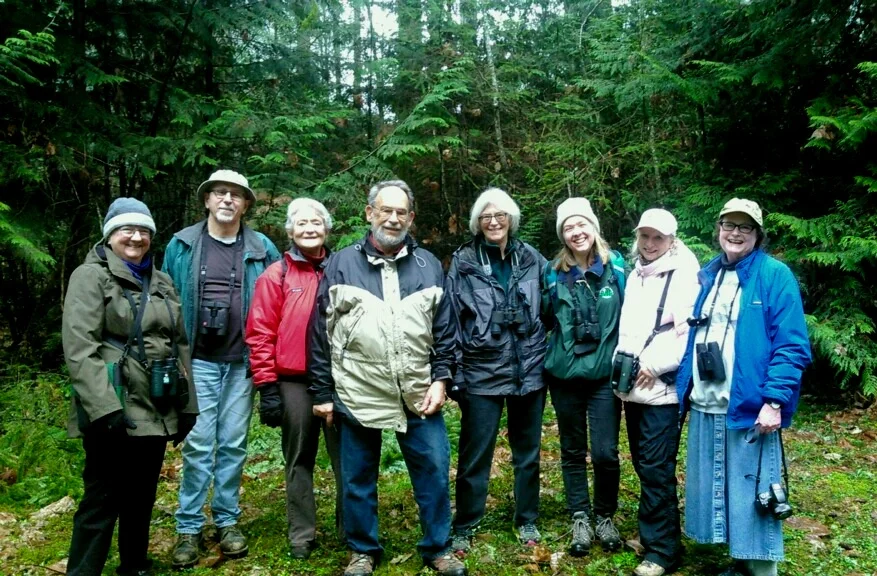
Today a talented crowd of birders woke up early (as birders do) to participate in Sound View’s first ever bird count. We were lucky to not see a drop of rain and had a wonderful time watching birds. I (Nancyrose) learned a lot from their knowledge and saw so much more than usual through their powerful spotting scopes! I hope to make the bird count something that happens every season, whether with visiting students, summer camps, or family camps, so that we can keep track of the changes in species throughout the year.
If you’d like to schedule a birdwatching experience on your next retreat or for your school group, let us know! We have enough binoculars for a group of 15 people.
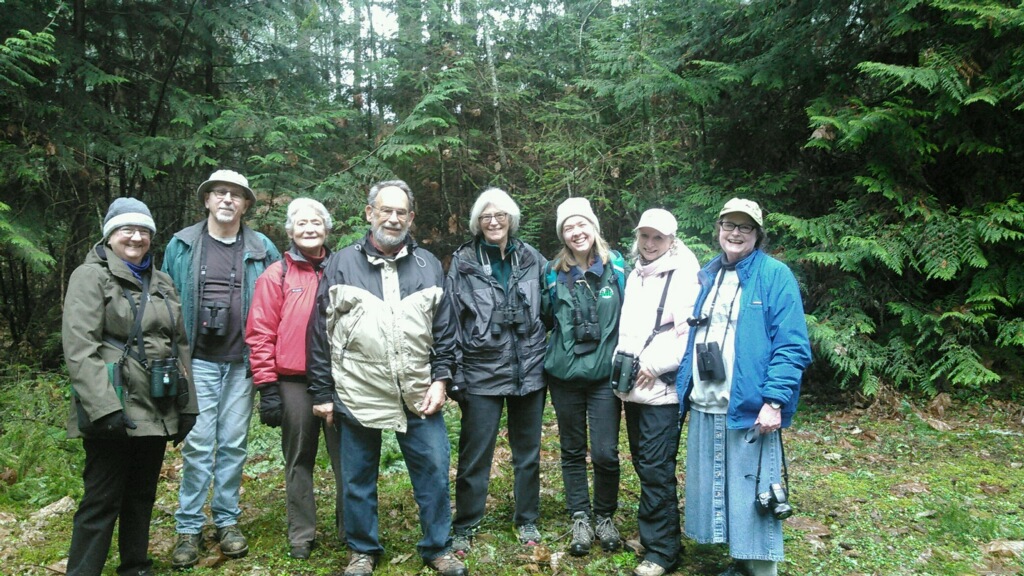
We started out in the forest, where knowing how to bird by ear is a must. I am still only able to distinguish the most obvious bird sounds one from another, but my companions were able to clue me in on what we were hearing. I have a lot to learn!
We heard the following birds in the woods. The only ones we actually saw of this bunch were the raven, a junco, and a few robins.

Pacific Wren — photo by Cameron Eckert, https://www.allaboutbirds.org
Song Sparrow
Fox Sparrow
Bewick’s Wren
Pacific Wren
Robin
Golden-crowned Kinglet
Ruby-crowned Kinglet
Black-capped Chickadee
Yellow-rumped Warbler
Raven
Junco
My companions grabbed their spotting scopes and we headed down to the beach, where we finally started seeing some birds rather than just hearing them! The beach is the best place to bird with visiting students and summer campers, because you can see so many species without trees in the way. It seemed like every time we looked, there was another species of birds - we saw all three species of mergansers, two types of loons and grebes, and many surf scoters, which I had never seen before. We also spotted two seals observing us curiously from the water and a passel of sea lions lounging on the channel marker, as usual.

Male Surf Scoter — photo by Brian Sullivan, https://www.allaboutbirds.org
My favorite sight of the day was a floating log on which a great blue heron and two, then three, cormorants were sitting. The log was floating at least 300 feet offshore, but they seemed content to sit there and let the tide take them where it may. It was probably a great spot to search for lunch! The cormorants, of course, had their wings stretched out to the side in that unmistakable M shape to dry them out. Cormorant feathers are not water-repellent like most water birds, so they have to dry them out in the sun (that is, on the rare occasions when it comes out here in the Pacific Northwest!) The full list of birds seen at the beach is below, with approximate numbers.
Spotted Towhee - 2
Common Merganser - 7
Red-breasted Merganser - 4
Hooded Merganser - 1
Surf Scoter - 25
Kingfisher - 1
Bald Eagle - 2
Pigeon - 2
Great Blue Heron - 1
Brandt’s Cormorant - 3
Double-crested Cormorant - 2

Male Bufflehead —— photo by Liron Gerstman, https://www.allaboutbirds.org
Common Goldeneye - 15
Bufflehead - 9
Common Loon - 1
Red-throated Loon - 2
Red-necked Grebe - 1
Horned Grebe - 4
Plus lots of gulls!
Northwestern Salamander

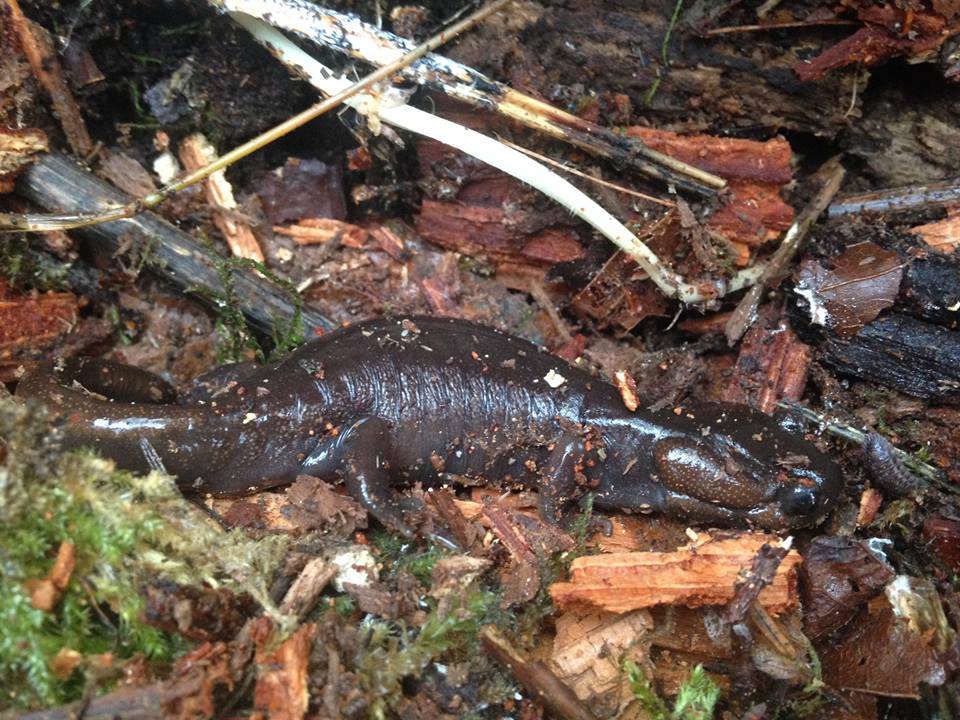
We found another little-seen creature at Sound View the other day when our AmeriCorps NCCC Pacific Region team members turned over a fallen log. This Northwestern Salamander was living underneath, so after taking a few pictures we put its house back in place. Northwestern Salamanders are less commonly seen at camp than Rough-Skinned Newts because they live underground and under rotting logs.