

Domestic Rabbits

Photograph of a faun rabbit resting inside.
Today, we're diving into the fascinating world of domestic rabbits, those fluffy creatures that can hop straight into our hearts. Sound View used to have a rescued bunny.
Did You Know? Baby Rabbits Are Called Kittens!
Just like cats, baby rabbits aren't called puppies; they're called kittens! These little fluffballs are born hairless and with closed eyes, but they quickly grow into the adorable bunnies we all know and love.
Carrots Aren't Always the Best Treats for Rabbits!
While it might seem like rabbits would love munching on carrots, it's important to know that carrots are high in sugar and should only be given as an occasional treat. A rabbit's main diet consists of hay, fresh veggies, and pellets to keep them healthy and happy.
Bunny Binkies: The Joyful Rabbit Dance!
Ever seen a rabbit hop, twist, and kick in the air? That's called a bunny binky! It's a sign that your rabbit is feeling super happy and excited. Imagine a bunny doing a little dance to express its joy – that's a binky!
The Scoop on Rabbit Droppings: They Eat Their Own Poop!
Yes, you read that right! Rabbits have a unique digestive system, and to get all the nutrients they need, they eat their own poop. It's not as gross as it sounds; the soft, nutrient-rich pellets they produce are different from their regular droppings.

Rock Cycle
What happens to rocks after they are formed?
On Friday we learned about different types of rocks and how they were formed. If you missed it, you can see that lesson here: http://www.soundviewcamp.com/nature-blog/2020/4/10/types-of-rocks
Today we are going to learn about what happens to rocks after they are formed.

Photo: eschooltoday.com
Rocks on Earth’s surface are exposed to many things that break them down into smaller pieces of rock. This process is called weathering. Wind, water, chemicals, and natural disasters all cause weathering. The wind itself may cause pieces of rock to break off it’s parent rock but even more likely is that wind can carry something such as sand that wears away at rocks. Water is often the culprit of weathering. Think of the Grand Canyon. Overtime the force of the water pushing against the sandstone carved a deep path, the canyon. This happens with ice as well. The Puget Sound was formed by glaciers that carved out the path that water now fills. Often water, liquid or solid, will also carry rocks with it. When these rocks hit other rocks it causes weathering as well. Water can also get stuck in the cracks of rocks and freeze. When water freezes it expands, causing the crack in the rock to get wider until it breaks off. Earthquakes, landslides, volcanic eruptions and more are also responsible for weathering.
After the rocks break they are carried away from their original location and brought somewhere else. This process is called erosion. Wind, water, and natural disasters move rocks in addition to breaking them. Gravity is another force that causes erosion. As the rocks travel away from their original location they may be dropped in another location such as the base of a mountain, the end of a river, or a sand dune. This process is called deposition. Sometimes these small rocks, such as sand, move again but sometimes they stay there. As more sand, silt or mud piles up in layers, it can eventually create sedimentary rocks.

Photo: USGS.gov
The rocks that are underground go through different changes. Some maybe transformed into a metamorphic rock by heat of magma or the pressure of rocks being pushed together. In some areas of the Earth, the rock gets pushed underground and is melted, joining the underground magma. This magma can then become either intrusive or extrusive igneous rock. This process is called subduction and is currently happening off our coast.

Rock Cycle Photo: forbes.com

Bird Eggs
Why are robin eggs blue? Learn what the color of eggs can tell us about birds

The robin egg. The blue color comes from a pigment called biliverdin.
Walking through Sound View’s forest yesterday, I found a robin egg laying in the middle of the trail. I knew it was a robin egg because they lay incredibly blue eggs. Though I was excited to find this egg, I was also saddened because it meant the egg was no longer in the nest and therefore unfortunately will not survive. It also make me wonder why these eggs are blue and what makes them have this color.
One of the defining characteristics of birds (Class Aves) is that they lay eggs with a hard calcium shell. This is unlike other egg laying vertebrates as amphibians and fish lay eggs without shells and reptile eggs have a shell that is generally softer. The hard outer shell of a bird egg makes it possible for the parents to sit on the egg to keep it warm. It also means that the baby bird needs a way to crack the shell from the inside in order to hatch. They use their beak and an “egg tooth” that they loose once they hatch. (Reptiles with tougher shells like crocodiles and turtles also have an egg tooth).
Inside the egg is everything the chick need in order to develop to the point that they are ready to hatch. So, why does the color of the shell matter in the baby bird’s survival? Many eggshells have colors that help them camouflage, or blend in with the nest. These eggs tend to be grey to light brown and sometimes have dark spots or other markings on them. Some egg colors help protect it from the Sun’s ultraviolet (UV) rays that may damage the chick as it grows . Darker eggs help protect the growing chick from UV rays but are not good in direct sunlight because they will overheat, causing problems as the chick grows. Lighter eggs do not do as well against UV rays but they stay cooler. Scientists think the blue-green color might be like a middle ground between those two options, protecting the egg from UV rays while still keeping it relatively cool. The color shade of bird eggs not only differs with different species of birds, it also is different within species. A bird of one species that lays eggs in a sunny area of the world can look slightly different than a bird of the same species that lays eggs in a cloudier part of the world.
Egg color can tell us a few other things about the egg as well. It can tell us a little about the bird’s behavior as more camouflaged eggs tend to come from species that leave their nest unattended to find food. Brighter eggs tend to be better guarded by the parent birds. If there is an egg in the nest that is very different from all the rest it may be an egg of a different species that was laid in hopes that the owners of the nest will raise it as one of its own. Lastly, the brightness of the eggs can be determined by the health of the mother and therefore the chick. Brighter eggs tend to mean healthier birds. One study showed that brighter robin eggs may cause the father of those eggs to help care for them more (https://www.sciencedaily.com/releases/2012/05/120514122838.htm ).
This is an excellent article about bird eggs: https://www.thespruce.com/why-robin-eggs-are-blue-4161031


Stinging Nettle
Though the stings are irritating, this plant can be quite useful.

Stinging Nettle (Urtica dioica) is a plant that many people dread running into on the trail. Despite the pain it causes, it is a very interesting and useful plant. Subspecies of this plant are found in many parts of the world, especially in moist forests and riparian zones, along rivers/streams.
Stinging Nettle gets its name from the needle-like hairs, or trichomes, on the stems and bottom of the leaves. When the trichomes come in contact with something like an animal’s skin they inject chemicals: acetylcholine, formic acid, histamine, and serotonin. The formic acid causes some of singing sensation. Some ants also use formic acid to protect themselves. Histamine is what your body releases when something you are allergic to enters your body. This chemical, alongside with acetylcholine and serotonin, causes a rash to form and may cause some of the pain as well.

Stinging Nettle Flowers
The stinging adaptation that Stinging Nettles have discourages many animals from eating it. However, some caterpillars and aphids are able to munch on the leaves. When it is dried, cooked, or carefully picked it can be eaten by humans and livestock. Stinging Nettle is actually very nutritious. It contains many vitamins and minerals in addition to it being high in fiber and protein. They are best when the leaves are new and the stalk is only about a foot high. The cooking process breaks the needles so they no longer sting. Boiling it also makes a tea that many people have used to treat various medical conditions. Not much research has been done to prove the tea is effective, however. Because they also have a lot of nitrogen, an element that plants need to grow, they are also often used in fertilizer and compost. Lastly, the strings in the stalk of the Stinging Nettle have been used in making textiles, or fabric.

Phylum Chordata
Learn about the animals that are in the same phylum as humans


The last of the major animal phyla is the one that we belong to: Chordata. Most species in this phyla are vertebrates, having a backbone. However, phylum Chordata has two subphyla of invertebrates: the tunicates and the lancelets. There are about 57,000 vertebrate species, 3,000 species of tunicates (Subphylum Tunicata), and 30 species of lancelets (Subphylum Cephalochordata).
The word “chordata” means “having a string or cord.” Therefore, the defining feature of phylum Chordata is the notochord, or “back cord.” All Chordates at some point in their development have this rod made of cartilage (the same material that is in our ear lobes). The notochord is located in the back of chordates and supports the nerve cord that is parallel to it. The nerve cord exchanges signals between the brain and the rest of the body. In vertebrates, the notochord is replaced by a spine made of cartilage or bone. Tunicates only have the notochord when they are young. When they become adults, they lose it and either settle down on the ocean floor or stay free floating in the water. The lancelets keep the notochord throughout their lives.
All chordates at some point in their development also have pharyngeal slits. These are openings in the throat area that early chortates used to filter feed, like today’s lancelets do. In fish, many of the pharyngeal slits form into gills that are used to get oxygen from the water. In other vertebrates, these slits turn into features in the face and throat such as a jaw, jaw support structures and parts of the inner ear.
One more feature that all chordates have in common at some point in their life is a tail that extends beyond their rear. The tail has no organs in it. In many vertebrates, this tail does have a continuation of the spine and muscles. Tunicates, frogs, humans, and apes lose their tail as they develop.

Phylum Echinodermata
Learn about the “spiny skin” creatures

Sand Dollars on Sound View beach
During low tide here at Sound View, you can see thousands of dark purple disks sticking out of the sand and if you are lucky, you may even find a star in the sand. Additionally, there are probably some tiny and fragile stars crawling through the mud under the water. These animals are all echinoderms. Echinoderms are a group of invertebrate animals that exclusively live in salt water. This phylum includes six thousand species of: sea stars, brittle stars, sand dollars, sea urchins, sea cucumbers. They come in a wide range of shapes, colors, and sizes. Though they are very diverse, they have many characteristics that link them together.

Spines and Tube Feet of a Sea Urchin Photo: https://en.wikipedia.org/wiki/Tube_feet
The name of the phylum, echinodermata, means “spiny skin.” Many echinoderms do have spiny skin, however some do not or have fake spines, like in many sea cucumbers. To an echinoderm, salt water isn’t only something they live in, it is their blood, source of oxygen, and used in their movement. Echinoderms have a “water vascular system.” this means the use water from the ocean in place of blood. They bring the water into their body through a madreporite, or “mother pore.” The oxygen in this water is brought and used by different parts of the body. They also use the water to power their tube feet. The tube feet look like a tube with a suction cup at the end. They use their hundreds of tube feet to move around, hold on to surfaces, and to move food towards their mouth. In the case of many sea stars, they also use their tube feet to pull on mussel/clam shells until the mussel/clam becomes too tired to hold its shells closed. Then the sea star will take its stomach out of its mouth and digest the inside of the mussel/clam.

Leather Star on Sound View beach
All echinoderms have pentaradial symmetry. This means that their bodies have five identical sections. You can see this most easily in sea stars because they will generally have five arms or five sets of arms. There are a few exceptions to this, such as the Six-rayed Star that can be found on Washington’s coast. Occasionally, a sea star may lose an arm to a predator. All echinoderms have incredible regenerative, or regrowing, powers though. So a sea star with a lost arm can grow it back and sometimes they accidentally grow an extra one. Sea cucumbers show of their regenerative powers as well. If they feel threatened, they will eject their guts so they can escape while the predator eats their guts. They can later regrow their lost body parts. Sea urchins and sand dollars can regrow parts of their body as well, especially lost spines or tube feet.
Echinoderms are incredibly important to ocean habitats. Sea cucumbers, sand dollars, and brittle stars eat dead material and bacteria on the sea floor or floating through the water. This helps recycle nutrients just like a decomposer does in the forest. Sea Stars are top predators of many ocean habitats. They help control the populations of mussels, clams, barnacles, sea urchins, sand dollars and more. Sea urchins are known for devouring kelp forests, especially when their population is not controlled by predators. They are a favorite food of sea otters. Although they do not look tasty with all those spines, humans eat urchin as well. It is commonly used in sushi and is called “uni.”

Phylum Arthropoda
Insects, spiders, crabs and more. Arthropods make up about 80% of all animal life!
The largest animal phylum is Arthropoda. Scientists have identified five MILLION different arthropod species currently living on Earth! This is about 80% of all living animal species. There may even be millions more because Arthropods are everywhere and many are so small it can be difficult to tell if they are different from another species.

Grasshopper Molting Photo: https://math.scholastic.com/issues/2017-18/101617/the-magic-of-molting.html#1090L
So, what are Arthropods? Chances are you have seen at least one today. The phylum Arthropoda includes all insects, crabs, spiders, centipedes, millipedes, shrimp, and more. All of these animals share a few features in common. One of these features is their jointed legs. This is what the phylum is named for: “Arthro-” means ”joint” and “-pod” means “foot.” Their body is also made up of segments. Many arthropods, like ants and flies, have three segments: head, thorax, and abdomen. Some arthropods, like millipedes, have way more than 3 segments and some, like spiders, have less. Spiders have a cephalothorax (head-chest) and an abdomen.
Without their joints, arthropods would have trouble moving around because their body is covered by a hard outer shell called an exoskeleton. The arthropod exoskeleton is made of chitin (KIE-tin). Chitin is similar to the protein that makes up our hair and nails, keratin. The chitin exoskeleton covers the whole body of arthropods, protecting them from predators and preventing them from drying out. This exoskeleton probably helped make arthropods the first land-dwelling animals. The exoskeleton does make the growing process interesting for many arthropods. They grow larger within a rigid, smaller shell. In order to grow, arthropods must shed, or molt, their exoskeleton. When crabs do this, for example, they back out of their too small exoskeleton and then fill their body with water, expanding their new outer shell. Now their new shell is a little too big for them and they have some room to grow. When they molt, their new shell is soft and they are more vulnerable. They need to find a place to hide until their new exoskeleton hardens. Molting also gives animals a chance to regrow a lost leg or antennae.

Photo: https://wdfw.wa.gov/sites/default/files/publications/00028/wdfw00028.pdf
All Arthropods go through metamorphosis, or changing of their body shape. A baby arthropod often looks very different from the adult. The classic example of this is a caterpillar turning into a butterfly. The young form of an arthropod, after they hatch from their egg, is called a Larva. Then, depending on the arthropod, they may have a nymph or pupa stage before becoming an adult. I really like the metamorphosis of crabs because larval crabs, or zoea, are basically unicorns.
Arthropods are extremely important to all life on Earth. All arthropods are food for other animals, including other arthropods. Even humans eat arthropods: crab, shrimp, lobster, and many different insects! Many zooplankton are arthropods, controlling the phytoplankton population and acting as prey for many larger marine animals. Many arthropods are also decomposers, helping recycle nutrients in an environment. Arthropods also pollinate flowers, helping plants reproduce. Even spiders, an arthropod that is a common fear among humans, is extremely important in controlling populations of other arthropods such at mosquitoes, flies, wasps, and more. Think about this the next time you feel the need to squash a “bug” or a spider. Escort it back outside instead.
Here are a few arthropods I have photographed at camp:


Worms!
The wriggly world of worms!

Earthworms at camp
When flipping over logs or digging in your backyard, you are likely to find an earthworm hiding from predators in the moist soil. Earthworms are a very important part of the forest, helping decompose matter to recycle the nutrients in the soil. They are also often used in compost systems to break down fruits and veggies into compost that can be used in a garden. Although there are over 1,800 species of earthworms, they are just a small portion of the worms on Earth. Worms are common in many environments all around the world. Marine worms are some of my favorite creatures to find when exploring the beach.
The animals we call “worms” actually belong to nine different phyla. The most common worms are found in three of those phyla: Platyhelminthes, Nematoda, and Annelida. All worms are invertebrates, having no bones. Most worms have head and tail ends, as well as simple organs. They even have a simple brain.
Platyhelminthes

Can you find the eyespots? Photo: https://www.nwnature.net/hood_canal/index.htm
This is the phylum of flatworms. Flatworms can live on land or in the water (salt and fresh). Many are parasites, feeding off a host animal. Some flatworms live symbiotically with other organisms, helping their host in some way and gaining food from them. The species that live without a host are predators, eating other small animals. Non-parasitic flatworms are small, generally no more than four inches long. Occasionally, if I am lucky, I find a flatworm on the beach under a rock or shell. I like these worms because they look like they have eyes. They are not complicated eyes like we we have, but they are known as eyespots and can detect light and dark. While the flatworms I usually find blend in with the rocks, there are many marine flatworms that brightly and beautifully colored.
Nematoda

Caenorhabditis elegans is often used in scientific experiments studying DNA GIF: https://manoa.hawaii.edu/exploringourfluidearth/
These roundworms may be the most common worm in the world. If you have never seen one it may be because many free-living roundworms are very small, often microscopic. Nematoda means “thread-like.” However, there can be thousands in a small handful of damp soil. Roundworms can be herbivores, carnivores, or parasites. They are the simplest animal with a one-way digestive system. Their food enters in a different place from where their waste leaves, unlike Cnidarians and Platyhelminthes. If the environmental conditions around them are bad, roundworms can go dormant. They will wake up once the conditions are right again.
Annelida

Polychaete on camp’s beach. Do you see the segments?
This phylum of worms is likely the one you are most familiar with because it includes earthworms. Annelida comes from a Latin word meaning “rings.” This is the phylum of segmented worms. Look closely at an earthworm and you will see their body appears to be made of rings that are stuck together. The lines on their body separate the segments of the worm. They have more advanced organs than the other two worm phyla I have mentioned, including a closed circulatory system where their blood stays in hearts and blood vessels instead of just floating around the body. They have five heart-like organs! Leeches are another member of this phylum. We can also find many Annelids on our beach, from the Polychaete “Clam worms” underground to the tube worm tubes sticking out of the sand or attached to the pier pilings. Polychaetes are another favorite of mine to find because the look like they have little legs. These legs are called setae and are bristle-like projections that help them dig through the sand. I have to be careful when pulling them out of the ground because some species have a venomous bite. Also, because they are segmented, they break easily. This is actually a strategy to protect themselves. If a predator gets a hold of the worm, the worm can break and then regrow their lost part of their body.

Phylum Mollusca
This post is brought to you by the Banana Slug and its soft-body friends

Banana Slug
What do snails, clams, and octopuses all have in common? As members of the phylum Mollusca, they all have soft bodies. “Mollusc” comes from a Latin word meaning “soft.” Mollusks can be found in many habitats all over the world. They can live in fresh water, salt water, or on land. Because of their soft body, they do require some moisture to survive. However, there are a few snails that have adaptations that allow them to survive in dry deserts. Mollusks produce a mucus (slime) to retain moisture and to help them move around. Mollusca is the second largest invertebrate (animals without a backbone) phylum, with a species count of around 100,000. Members of the phylum Mollusca that live in the ocean make up about one fifth of all named marine species.
Mollusca is a very diverse phylum. For most generalizations you can make about members of this phylum, there are often many exceptions. For example, most mollusks have a shell or a remnant of a shell. This is not true for many slugs and for octopuses though. There is also on class of Mollusks called Aplacophora, which literally means “without a shell.” These are all worm-like mollusks that live on the bottom of the ocean.
Most mollusks have three body sections: a head, a foot, and a mantle (body cavity). In the head, most mollusks have a radula and a simple brain. The radula is like a rough tongue that mollusks use to scrape and grind their food. (Clams do not have a radula). Mollusks have a simple nervous system that has one nerve chord for the foot and one for the mantle. They come together near the head in a ring shaped collection of nerves, their brain. The esophagus, where food travels from the mouth to the stomach, runs through the center of this brain ring. The mantle, or body cavity, contains their organs, including: their gills for breathing, heart(s), digestive system, and reproductive system. This is also the part of the body that makes the shell, if they have one. The foot is a muscle used for moving around and attaching themselves to surfaces. For squid, octopus, and cuttlefish, their “foot” is modified into tentacles that primarily help them eat. They use a siphon, or small tube shaped hole in their body, to move by pushing water through it.

Limpet
The largest class of mollusks is Gastropoda, which means “stomach foot.” This includes sails and slugs. They make up about 80% of all mollusks and are incredibly diverse. They come in all sorts of shapes, sizes, and colors. Common Gastropods around camp include: Banana Slugs, Moon Snails, Garden Snails, Nudibranchs (sea slugs with their gills on the outside of their body), and Limpets (dome-shaped marine snails).

Horse Clam
Another common class of mollusks we see is Bivalvia. Clams, Mussels, Oysters, and Scallops are all members of this class. Bivalves are known for having two shells that strongly hold together, protecting the soft body inside. These mollusks do not have a head or radula. Instead they use siphons to filter feed as they bring water into their body. Through doing this they also help clean the water around them. This does mean though that if there are toxins in the water, they will collect these toxins in their body. For the bivalves that dig, like clams, their foot is modified to help them dig into the sand. We can find Pacific Oysters, Bay Mussels, and many species of clams on our beach.

Squid eggs
Octopuses, squid, cuttlefish, and nautilus all belong to the class called Cephalopoda, meaning “head foot.” This class contains the smartest of the mollusks. Octopus have been known to solve puzzles and escape aquariums. Their radula is modified into tooth-like structures and their foot is modified into tentacles. Many can change color for camouflage and communication with members of their species. In squid and cuttlefish, their shell is a support structure just under the skin of their mantle. Octopus have lost their shell completely. The Puget Sound is home to the largest species of octopus, the Giant Pacific Octopus. Market Squid also frequent the Puget Sound. If you are lucky, you can find squid eggs on the beach at low tide.

Black Leather Chitons
One more type of mollusk you may be able to find on our beach is a chiton. Chitons are a lot like limpets but instead of one shell, it has eight shell plates. Their class name, Polyplacophora, means “many plates.” This gives them more flexibility. If they are removed from a surface, they can roll up into a ball to protect their soft body. They can be difficult to spot as many blend into the rocks and they look like a fossil.
Speaking of fossils, because of their shell, mollusks are abundant in the fossil records. This has helped scientists learn about the history of many mollusks.

Phylum Porifera
Sea Sponges!

Can you find the little Red Nudibranch on this Red Sponge?
Our next phylum in the Kingdom Animalia is Porifera. Phylum Porifera is the phylum of sponges. These are not the rectangular sponges you may have in the kitchen nor do they live in undersea pineapples. Most of the 5,000 identified sponge species do live in the ocean. Only about 150 of the recognized species live in freshwater. Unlike Spongebob, members of the phylum Porifera spend most of their lives attached to a surface such as a rock. The only time they move around is at the beginning of their lives when they are free-floating larvae. However, as larvae, they cannot control their movement against a water current.
Sponges are one of the most simple animals. They have no organs or even tissues (collection of specialized cells that are grouped together and all do the same thing for the body). They do, however, have specialized cells that perform different jobs so the sponge can survive. These jobs include: structure support, growth, repair, reproduction, and feeding.

The large holes visible in this purple sponge are the oscula.
Perhaps the most notable feature of sponges is the pores, or holes, in their body. The word “porifora” means “pore bearer.” These pores are called ostia and are important for the way that sponges capture food. Sponges eat by bringing water in through these ostia and with that water comes plankton, microscopic organisms. The sponges cells then absorb and digest the plankton. As the water is brought in through the ostia, it creates a one-way current through the sponge. The water leaves through a hole called an oscula. Even though sponges come in many shapes, sizes, and colors, they all have this same basic body plan.

Boring Sponge Photo: http://pugetsoundblogs.com/sea-life/5/
Sponges play an important role in the ocean. They are a fantastic food source for fishes, sea slugs, shrimp and more. They also provide habitat for many sea creatures to live in. Sometimes algae grows on sponges as well. One type of sponge called a boring sponge because it bores holes through shells to have a safe place to live. Unfortunately, if the owner of the shell is alive when the boring sponge starts breaking away at the shell, it will not survive. However, this sponge is important for recycling the calcium that the shell is made out of so other shelled animals can use it to build new shells.
Sponges are important not only to the ecosystems they live in but they also are being studied for their potential to have chemicals that could helpful for humans. Some of these chemicals may have anti-cancer, anti-malaria, pain killing properties, and more. Sponges either make these chemicals themselves or get them from their food and repurpose the chemicals for their own use. These chemicals help the sponge avoid getting eaten, fight other sponges for growing space, wear through rock/shell, and repel parasites/harmful bacteria.
The video below shows the current that sponges create through their body.

Phylum Cnidaria
Learn about the phylum that includes anemones, corals, and jellyfish.
For the next few posts, I plan to go over the main phyla of the kingdom Animalia. Today’s post is about the Cnidarians (nahy-dair-ee-uh ns). Jellyfish, anemones, and coral all belong to this phylum. Check out the Cnidarians we have in the Puget Sound at this site: http://www.bily.com/pnwsc/web-content/Cnidarian%20Identification.html

Aggregate Anemone on Sound View’s beach

Nematocysts Photo:http://www.mesa.edu.au/Cnidaria/default.asp
Cnidarians are most known for the fact that they have stinging cells, or nematocysts. They use these stinging cells to catch their food and protect themselves. Nematocysts work a lot like a harpoon. The cells have “trigger hairs.” When something touches them, they release the microscopic “harpoon” that goes into whatever touches it and releases a venom. The strength of the stinging effect varies by species. The sting of a Box Jellyfish can potentially be fatal to humans where the sting of the Plumose Anemone, a local species, is barely noticeable. Of the Cnidarians that are most common in Washington, the Lion’s Mane Jelly is the only one that has a notably painful sting. It is not generally life threatening. The sting of the anemones you can find at the beach is so mild they their tentacles just feel sticky.
Cnidarians are invertebrates, meaning they have no bones. They have very simple bodies with no organs. Their gastrovascular cavity, where they digest their food, only has one opening to it, their mouth. They get water and oxygen by simply absorbing into their bodies and they get rid of bodily waste by releasing it out of their cells or out of their mouth. They also have radial symmetry. You could “cut” a Cnidarian in half in anyway through the center and both sides would be identical.

Photo:http://www.mesa.edu.au/Cnidaria/default.asp
They have two types of body plans: the medusa and the polyp. The medusa is the typical jellyfish shape with a round bell on top and tentacles hanging down. They are free floating, though most cannot control their body movement against the water current. Their mouth points down. The polyp is the typical anemone shape. The body is generally stuck to something and the tentacles reach up. Some anemones can move where they are attached to but for most, it is a slow process to do so. Their mouth points up.
Jellies go through both the polyp and medusa shapes in their life. After they hatch from an egg, they are a free floating larva that settles down on something as a polyp. Once the polyp is big enough, it divides into many individuals that grow into medusa forms. Anemones and coral are polyps for their whole lives. Coral is a made up of a colony of polyps that, in many species, creates a calcium carbonate skeleton to live on. Coral also has a symbiotic relationship with an algae known as zooxanthellae. The algae uses sunlight to make sugar that feeds the coral polyps and the coral offers protection and carbon dioxide. Some anemones develop this relationship as well. Zooxanthellae is often what causes the bright colors of corals and some anemones.

Photo:https://ucmp.berkeley.edu/cnidaria/ctenophora.html
BONUS PHYLUM: There are a few sea jellies that belong to another phylum. Comb Jellies of the phylum Ctenophora (ti-nof-er-uh). While the comb jellies share a lot in common with the Cnidarian jellies, they do not have stinging cells. They do have specialized hairs, or cilia, that help them move and catch food. They also have sticky cells that help them catch food. Many Ctenophores are bioluminencent, producing their own light.

Taxonomy Part 2
Learn about the taxonomy of the Sea Otter!

Yesterday, I explained what taxonomy was and gave a brief introduction to the 8 levels we use to describe and organize the organisms of the world. Check it out here: http://www.soundviewcamp.com/nature-blog/2020/5/14/taxonomy
Today, I am going to go through the basic 8 levels and what they mean for my favorite animal, the Sea Otter.
Sea Otter Taxonomy

Photo:https://www.expii.com/t/levels-of-organization-within-organisms-cells-10023
Domain: I I mentioned yesterday, there are 3 domains: Archaea, Bacteria, and Eukarya. The first 2 are single-celled organisms that do not keep their DNA enclosed in a nucleus. The domain Eukarya includes single-celled and multi-celled organisms that do enclose their DNA in a nucleus. This is the domain that Sea Otters are in.
Kingdom: Within the domain Eukarya, there are four kingdoms: Plantae, Fungi, Protista, and Animalia. Sea Otters belong in the kingdom Animalia, or animals, because their body is made up of multiple cells that do not have cell walls, they need to eat other organisms to gain nutrients (Heterotrophic) and they are capable of motion in some point in their life.
Phylum: In the kingdom Animalia, there are about 35 phyla. Nine phyla out of the 35 cover most of today’s living species. The phylum that Sea Otters belong to is called Chordata. This phylum consists of animals that at some point when they are growing have: a notochord, a dorsal hollow nerve cord, gill slits, and a tail that extends beyond the end of the digestive system. A notochord is a supportive rod made of cartilage, the same material in your ear lobe. For many members of phylum Chordata, the notochord is replaced by a backbone. We call these animals Vertebrates. Although Sea Otters do not have gills when they are born, they have them for a short time while they are developing as an embryo. This is the case for many animals in this phylum.
Class: Within the phylum Chordata, Sea Otters belong to the class Mammalia. Sea Otters are mammals because they produce their own body heat (endothermic), have fur, give live birth, have mammary glands that produce milk for mothers to feed their babies, and have a complex brain. This is the last level we, as humans, share with Sea Otters.

Sea Otter Skull- Note the teeth Photo: http://www.skullsite.co.uk/Sotter/sotter.htm
Order: The order Sea Otters belong to is Carnivora. Members of this order are typically meat-eaters, or carnivores. There are some exceptions to this as a few members are omnivores, meaning they eat both meat and plants. An example of this are bears and raccoons. The Panda belongs to this order as well even though it is herbivorous, only eating plants. Carnivora are typically noted by their pointed teeth that are used for tearing meat. They can also only move their jaw up and down. They cannot move it side to side like humans and other primates can. Sea otters crack open shells and chew their food more than most Carnivora members so their back teeth are flatter than dog or cat teeth are.
Family: Sea Otters are members of the Mustelidae family. This family group is known for typically having long bodies, short legs, rounded ears and a powerful bite. Most member also have scent glands that they use for mating, marking territory, or in the case of a skunk, for protection. Though river otters have sent glands, Sea Otters are an exception to the sent gland rule. They spend their whole lives in the water where sent glands are not useful. Other members of this family include weasels, badgers, skunks and wolverines.

Photo: https://medium.com/@exploreorg/explore-org-and-seaotters-com-aed4f4080ec8
Genus: Enhydra is the Sea Otter genus. Sea Otters are the only extant (existing) member of this genus for fully aquatic otters. Enhydra means “in water.” There is one extinct member of this species, an otter that lived in the Eastern Atlantic ocean around two million years ago. All otters belong to the Subfamily Lutrinae. There are many genera of otters. Today’s otter species are represented in eight different genera.
Species: The species of the Sea Otter is Lutris, which means “otter.” This makes the scientific name of the Sea Otter: Enhydra lutris. There are three subspecies of Enhydra lutris. They are seperated into subspecies because they live in different area’s of the Pacific Ocean: Southwestern coast of North America, Northwestern coast of North America, and Northeastern coast of Asia.
In learning about the taxonomy of an organism, you can learn a lot about the characteristics, ancestors, and relatives of the species. I encourage you to do this for a species you are interested in to see what you learn about them!

Taxonomy
How do we name and organize the creatures of the world?

Photo: Wikipedia
In many of my blog posts about animals and plants, I often mention at least the species’ “Latin name”. Occasionally, I also mention a Family or Order that that animal is in in order to share what other organisms are related to them. These ways of describing living things and organizing them into groups of similar living things is called Taxonomy. Taxonomy helps us understand how organisms are similar and/or different from each other. It also gives scientists all around the world a common language to use when talking about these organisms.
Humans have been classifying organisms for a very long time. The current way of categorizing and naming organisms was started by a scientist named Carl Linnaeus in the mid 1700’s. He came up with a system that had 7 levels. As the world discovered more and more organisms, we added another level as well as some sub-levels to properly organize Earth’s organisms. Each level groups organisms together based on similar traits. Linnaeus and scientists of his time had to use only traits that they could see. Today, we not only use visual traits, but also DNA to help us categorize. He also started the idea of what we now call the “scientific name.” This is also known as binomial nomenclature, or the “two name way of naming.”
Most organisms have multiple names they are called by. They common name is what the organism is commonly called by people of the area. An organism can have many common names because people of different areas call them different things. For example, the rolly-polly also known as the potato bug, pill bug, woodlouse, sowbug, doodle bug, etc. These names are also given to many species of similar looking bugs. The scientific, binomial name for one species of these animals is Armadillidium vulgare. That way if you are a scientist studying rolly-pollies, you and all other rolly-polly scientists know exactly which species is being discussed no matter the common name that they use.
So, how do we get the scientific, binomial name? It comes from the organism’s genus and species name. Before we get to these two ending levels, let us learn what all of the levels are:

I like to think of each level as a set of boxes. The domain boxes are the largest and currently there are three of them. All organisms on Earth are put into one of the three “domain boxes.” Also within that box are multiple Kingdom boxes that divide the organisms even more. Within one Kingdom box, there are many Phylum boxes, and so on until you get to species. A species is group of similar individual organisms that can successfully breed, or have babies. So the scientific, binomial name of an organism includes the last two levels (genus and species) because they are the most specific way to identify an organism.
These categories also help us learn about the common ancestors that organisms share. Organisms with similar traits and DNA have at one point all come from one common ancestor that no longer exists. Organisms that all belong to the same genus share a more recent common ancestor than all of the organisms in one domain.
So if we take any organism, we can learn more about it based on the taxonomic “boxes” they fit in. In an effort to keep things short today, this is what I will do in tomorrow’s blog post. You can suggest an organism in the quiz below.

Turkey Vultures
How can Turkey Vultures not get sick from eating dead animals?

Photo: https://stevecreek.com/turkey-vulture-eating-an-armadillo/
While hanging out with the farm animals this morning, I was thinking about what I wanted to write about today when three Turkey Vultures flew overhead. Don’t worry, they aren’t after out turkeys or any of the other animals on the farm. They are scavengers, looking for prey that is already dead. Turkey Vultures (Cathartes aura) got their common name because their bald, red head resembles the heads of Turkeys. Although they are not incredibly common in most of Washington, it is considered part of their range in the breeding season.
Many of the unique features that Turkey Vultures have are because they are scavengers. As scavengers, they look for freshly dead animals to eat. Their prey could be left over from another animals kill, road kill, or have died due to natural causes. Dead animal bodies are often called carrion. They tend to only eat carrion that is less that 48 hours old. They find their food by soaring in the sky and using their senses of sight and smell. Typically, birds don’t have a strong sense of smell. Turkey Vultures and other species of vultures are the exception, smelling carrion from over a mile away. Their strong beak helps them tear bits off their food. Because they do not catch and kill their own food, their feet are weaker that a hawk’s or eagle’s. They look more similar to Turkey feet.

Photo: https://www.audubon.org/field-guide/bird/turkey-vulture#photo5
Carrion attracts more scavengers than just Turkey Vultures. Many decomposers such as invertebrates and bacteria get to work quickly, breaking down carrion and turning it into soil. Many of these decomposers would make humans and other animals sick. (We refrigerate/ freeze meat so it doesn’t attract the things that make use sick). Turkey Vultures have many defenses against getting sick from their food. Their featherless heads prevent them from having parasites crawling off of their food and on to their heads. They also have an incredibly acidic stomach that helps kill bacteria. Our stomach acid generally has a pH of between 1.5-3.5. It helps us kill many bacteria that may enter our digestive system. The pH of a Turkey Vulture’s stomach is close to 0. This means Turkey Vultures have a stomach that is around 100 times more acidic than ours.
Not only can their stomach acid protect them from bacteria inside their body, it also helps get rid of outside threats. Turkey vultures vomit to protect themselves from threats such as predators. Their vomit has a range of around 10 ft.

Photo: https://freepressonline.com/Content/Columnists/Birding-with-Don-Reimer/Article/Vulture-Venture-/50/100/60909
Turkey Vultures are frequently seen perched with their six-foot, black wings extended. This not only helps them warm up, but it may also be another way to get rid of parasites in their feathers. They expose them to the heat and harmful UV rays of the sun. If a Turkey Vulture gets too warm, it pees on its feet to cool itself off.
Now that you know all of these cool facts about Turkey Vultures, how do yo spot one? What flying, Turkey Vultures have a characteristic shallow “V” shape across their wingspan. Their bodies and front of their wings are black. The wings get lighter towards the tail of the bird. They are a similar size to a Bald Eagle but lack the white head. Instead, look for the small red head of the Turkey Vulture. They also are often seen in small groups where eagles tend to be more solitary. They are fun to watch as they fly circles in the air with rarely having to flap their wings. They use the natural air currents to keep them flying.


Squirrels
How many types of squirrels do we have in Washington? Find out here

Pile of Douglas Fir cone pieces Photo: Wikipedia
Walking through the forest at Sound View, I often find piles of Douglas Fir cone pieces near a stump of a log. When I see these, I know a squirrel is likely nearby. Every once in a while when I look for a bird making a chirping sound in the trees, I look up only to find it was actually a squirrel sounding off an alarm call.
Squirrels are another common animal we see around camp and in many other areas of Washington. Washington is home to nine squirrel and chipmunk species. Seven of those are native to Washington and the other 2 were introduced to the area by humans. Both squirrels and chipmunks belong to the rodent order along with mice, rats, beavers, hamsters, and more. The word rodent comes from a Latin word that means “to gnaw.” The front, incisor, teeth of rodents never stop growing so they are known for the fact that they frequently chew on things to help wear those teeth down.

Douglas Squirrel Photo: http://naturemappingfoundation.org/natmap/facts/douglas_squirrel_712.html
The most common squirrel seen in most neighborhoods and urban parks is the Eastern Grey Squirrel which is a non-native squirrel introduced in the early 1900’s. The native Western Grey Squirrel is labeled as a threatened species as it gets out-competed by non-native squirrels and is also facing disease and habitat loss.
The squirrel I see frequently running up the sides of trees at camp is the Douglas Squirrel. They are smaller than grey squirrels and have reddish fur on their belly. These squirrels are the culprits of the piles of discarded Douglas Fir cone bits. These piles, leftover from the squirrel’s meal of eating the seeds inside, are often called “middens.” Here is a video of a Douglas Squirrel’s alarm call: https://www.youtube.com/watch?reload=9&v=CEPr0ndcTsU

Northern Flying Squirrel Photo: nicbutler.weebly.com/
Most squirrels are diurnal, active during the day, or crepuscular, active during the morning and evening. However, one of Washington’s native squirrels is nocturnal, active during the night. This is the Northern Flying Squirrel. Despite the name, they do not fly. However, they can glide from tree to tree, thanks to the skin between their front and back legs that they use like a parachute.
Squirrels are foragers. eating whatever they can find in the forest. Most of their diet consists of nuts and seeds, but they also eat berries, insects, leaves, and mushrooms.
Chipmunks are very similar to squirrels. They can be identified by the black and white stripes that run down their back. They also have cheek pouches that they can hold food and other material in as they run through the forest.
Both squirrels and chipmunks cache food around the forest so they can have a supply of food in the winter, when food is less available. Sometimes their food cashes remain unused or they forget where they put it. This helps the forest grow because they often cache seeds of the trees and bushes in the area. If these planted seeds are not dug up for later use, they grow into new plants.

Bald Eagle
Learn about out national symbol!

Bald Eagles are commonly seen and heard at camp in the trees and soaring over the waterfront. When you hear a Bald Eagle call (https://www.allaboutbirds.org/guide/Bald_Eagle/sounds#) it might not sound as you expect because many movies actually use a Red-Tail Hawk call instead of on of a Bald Eagle.

Juvenile Bald Eagle Photo: allaboutbirds.org
Bald Eagles are not actually bald. They get their name from the white feathers on their head making them look “bald” in contrast to their brown body feathers. A juvenile Bald Eagle lacks the characteristic white head. Instead they have a mixture of brown and white feathers all over their body. They will get their white head feather at around five years old. At this time, they will also find a mate that they will most likely stick with for the rest of their lives. They may live to be about 28 year old in the wild.
Bald Eagles are predatory birds. They live near bodies of water and primarily dine on fish. They are not picky however and will eat reptiles, amphibians, other birds, and small mammals. They also often scavenge left over meals from other animals and will even steal another animal’s food. Their long talons, strong grip, 7 foot wingspan, and sharp beak help them be a successful aerial hunter.
Though Bald Eagles are a common sight in Washington today, that hasn’t always been the case. They have a great conservation success story. In 1782 they were designated the national symbol of the United States. At this time there was estimated to be over 25,000 individuals in the area that is today’s continental United States. In 1963, there were less than 1,000 birds left , labeling them and endangered species. Their population declined due to many human caused threats including: illegal hunting, lead poisoning (ingested lead bullets through prey), habitat destruction, and pesticides (also ingested through prey). Pesticides can have many affects on animals. One famous one called DDT caused eggs that birds (not just Bald Eagles) to become weaker. This prevented many Bald Eagles and other birds from successfully having babies to continue the population. Since the banning of DDT in 1972, conservation efforts have been successful in increasing the Bald Eagle population. Though Bald Eagles still face human caused threats today, they are no longer endangered and there are over 10,000 individuals in North America.
This success story shows us that we can make a difference in protecting wildlife. Policy changes, protection/conservation efforts, and care for any animal can help keep them extant (meaning “in existence,” the opposite of extinct). What species conservation success story will you be a part of?


Deer
Can you spot the deer walking through camp?

How many deer do you see in front of Calvinwood?
Deer are a commonly seen animal around camp grazing on plants as they walk by. They are often so quiet that I am surprised when I look up to see them staring at me from the bushes or across the field.

The most common deer subspecies in Washington is the Columbian Black-tailed Deer (Odocoileus hemionus columbianus). There are about twelve subspecies from the species Odocoileus hemionus. A subspecies are groups of animals belonging to the same species, animals that can successfully breed and make offspring that can breed. What makes them a subspecies is that they are geographically isolated from each other, creating a population that looks slightly different than other populations of the same species. This subspecies can be found from Northern California all the way into Canada. Male deer reach up to 200lbs while females are smaller, weighing up to 130lbs.
In general, deer belong to the order Artiodactyla, or even-toed ungulates (hoofed animals), along with goats, sheep, llamas and many more animals. From there, they belong to the family Cervidae which includes man different species of deer, elk, reindeer, and moose. Like many of our farm animals, deer are ruminants and herbivores, plant-eaters. As a ruminant, in order to digest all the plant material they eat, they have a four-chambered stomach which allows them to better digest their food.
Deer also tend to be crepuscular animals, meaning they are most active in the mornings and evenings. As prey animals, deer have many ways to avoid a predator attack. Their long legs help them quickly run away at any sign of danger and their large, flexible ears give them the ability to hear all around them really well.

Every year, male deer grow and shed a pair of antlers. They use these antlers to fight other males for dominance. A male deer, or buck, grows larger and more branched antlers each year.
Female deer are called does and baby deer are fawns. The white spots on a fawn help it hid better in the low brush of the forest. As the deer grow and become faster runners, they lose the spots.

More Flowers!
We have more flowers coming and going around camp! Why do different plants bloom at different times?
As spring continues, more and more flowers are coming and going. Why do different plants flower at different times? How does a plant know when to flower?


Depending on the plant there are many things that can start the production of flowers. Day length, amount of sunlight, rain, and temperature are all factors that influence a plant’s signals to start blooming. This signal is in their DNA. In a simple definition, DNA is much like the microscopic instruction manual inside of every living thing on Earth. It produces proteins that tell living things how to grow and function. Different plants have different requirements for when they can start blooming. With some plants, once one starts blooming, it sends chemical signals, called pheromones, through the air to other plants of the same type to start blooming too. This way they can reproduce successfully.
The progression of flowers from different species blooming throughout the spring and summer is important because they provide food for pollinators and other animals. Long term changes in weather and temperature (climate change) are having an effect on when and for how long flowers bloom. The study of when plants bloom, seed, lose leaves, ect is called phenology. Phenology literally means “the study of phenomenons.” In this case we study the how climate affect the cycle of plant growth, a natural phenomenon. It is something you, as a citizen scientist, can help scientists collect more data on. posting pictures of flowering and non-flowering plants throughout the year on iNaturalist helps provide data for phenology research. Another great resource and way for you to help with phenology is through the National Phenology Network: https://www.usanpn.org/usa-national-phenology-network . Learn more about citizen science and iNaturalist here: http://www.soundviewcamp.com/nature-blog/2020/4/17/the-at-home-naturalist-citizen-science
Check out the flowers and more at our self-guided day adventures happening now! Find out more and register here: http://www.soundviewcamp.com/new-events/2020/5/6/sound-view-day-adventures

Whales vs Dolphins
What’s the difference?
I mentioned in Orcas: Part 1 that the alternative name for Orca, Killer Whale, is a misnomer (an inaccurate name) because Orcas are in fact part of the dolphin family instead of the whale family. So, what is the difference between dolphins and whales?


Blubber Photo: http://blogs.oregonstate.edu/gemmlab/tag/science/
Cetaceans
Dolphins and whales share many things in common, both belonging to a group of animals called Cetaceans. Cetaceans are aquatic, water dwelling, mammals. As mammals they are both endothermic animals that breathe air, produce milk, give live birth, and have hair. We humans also share these traits with them. As endothermic animals, they (and we) produce their own body heat and need to find ways to not lose that body heat. Most marine mammals, mammals that live in the ocean, retain their body heat through thick skin and modified fat called blubber. It is kind of like they are wearing a really thick wetsuit. Most adult Cetaceans has little to no hair so they can be more hydrodynamic, meaning they can swim easier through the water. All mammals breathe air, so cetaceans all need to surface in order to breathe but many are well adapted to holding their breath for a long time. Most dolphins have breath holding times of around 10 minutes but the deep diving Sperm Whale can be underwater for up to 90 minutes.
Odontocytes vs Mysticetes

Photo: https://iwdg.ie/fluke-facts/
Odontocetes (oh-don-tuh-seets) and Mysticetes (mis-tuh-seets) are groups of Cetaceans. Odontocetes are “toothed whales” including dolphins, porpoises, Orcas, Sperm Whales, Beluga Whales, etc. I know what you are thinking: “If Orcas and dolphins are “toothed whales,” how is an Orca not a whale?” Perhaps it is more correct to say: “Not only are Orcas toothed whales, they are also members of the dolphin family.” They share a more recent common ancestor with other dolphins than they do with Humpback Whales. The “toothed whale” distinction is important because other whales, the Mysticetes, have baleen instead of teeth. These whales include Humpback whales, Grey Whales, the largest mammal: the Blue Whale, and more. Baleen is made of the same thing our fingernails are made of, keratin. It is smooth on the outside and bristly, like a broom, on the inside of a whale's mouth. Plates of baleen line the roof of Mysticetes’ mouths and are used to catch small marine animals like zooplankton, krill, shrimp and small fish. The largest animal in the world eats some of the smallest animals in the ocean!

Overall, baleen whales tend to be larger than toothed whales. Because of their different ways of feeding (teeth vs baleen), they have different diets. Though their overall body structure is similar so they can be hydrodynamic, there are a few differences. All toothed whales have a fatty cavity in their head called a “melon” for transmitting sounds used in echolocation. Though baleen whales do use echolocation, they do not have this feature. Additionally, toothed whales are typically faster swimmers than baleen whales. The toothed whales also generally spend less time underwater between breaths. (The exception to that is the Sperm Whale, a toothed whale that spends over an hour under water and generally swims slower than baleen whales.) These traits are linked to the fact that toothed whales have one blowhole, the opening where they breathe, and baleen whales have two. Toothed whales take smaller and more frequent breaths where baleen whales take larger, less frequent breathes. Lastly, many toothed whales tend to be more social and travel in larger groups than baleen whales.
In summary, while dolphins are technically whales (Cetaceans) belonging to the toothed whale category (Odontocetes), there are some large differences that separate them from the baleen whales (Mysticetes).
One last wild fact: all Cetaceans belong to the Order Artiodactyla. This order also includes goats, sheep, llamas, and deer. This means whales and dolphins are distantly related to many animals we have at camp!

Salmon
Salmon help forests grow! Learn how here
Salmon have and continue to be an important part of Washington life. They are important food sources for many other animals on land, in freshwater, and in saltwater. Because Native Peoples who lived in this area relied on salmon as an important food source, salmon also became an important part of native culture. It remains an important part of the history and culture of Washington today.
Salmon are part of the family Salmonidae which also includes trout and charr. Often members of this family are referred to as “Salmonids.” Many of the fish in this family are anadromous, meaning they spend time both in salt and fresh water. In order to do this, their body must go through changes so they can survive in each habitat.
Types of Salmon in WA
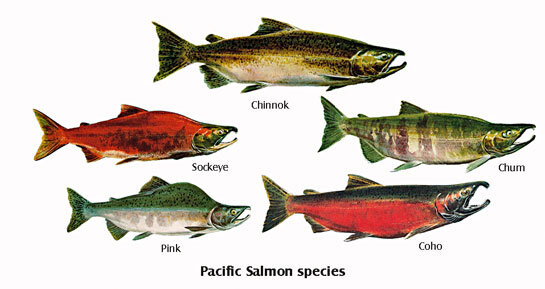
Pacific Salmon in Spawning form Photo: https://www.sanctuaryasia.com/magazines/talkin-tigers/9581-the-pacific-salmons-journey.html
There are 5 salmon species in Washington. An fun way to remember them is relating the types of salmon to each finger on your hand. Hold out one hand and with your other hand point to your thumb. Your thumb represents the Chum Salmon because Chum and thumb rhyme. Chum Salmon are sometimes called Dog Salmon probably because the spawning males develop teeth that kind of look like canine teeth. Point to your pointer finger. With this finger you could accidentally “sock yourself in the eye” so it stands for the Sockeye Salmon. Young Sockeye salmon live in lakes for up to two years before migrating to the ocean. Point to your middle finger. Because this is your tallest finger it represents the largest salmon species, Chinook Salmon. Sometimes these salmon are known as King Salmon and they are the preferred food of our resident population of Orcas. Next is your ring finger. Because you might place a silver ring on this finger, it represents the “Silver Salmon,” also known as Coho Salmon. These salmon often spawn in small streams that are close to neighborhoods, making them a popular sport fish. Lastly, your pinky finger represents the Pink Salmon. These salmon develop a hump in their spawning form, earning the nickname “Humpback Salmon.” They also only spawn in odd years because they have a very regular life cycle where they return to their home stream to spawn after living in the ocean for 2 years. There are 3 other Salmonids native to Washington: Steelhead, Bull Trout and Cutthroat.
Salmon Life Cycle

All species of salmon have a slightly different life cycle. They may spend more time in one stage than other salmon do. This is the general life cycle of salmon: Salmon start their lives as eggs in the gravel of a stream bed. Once they hatch, they still have their yolk sac and they use this as nutrients to grow larger. This stage is called the alevin. Once their yolk sac is absorbed, they become fry and need to start finding their own food. They eat freshwater invertebrates. When the salmon start heading to saltwater, their body starts going through a process called “smoltification” so they can survive in the salty water. This next stage is therefore called a smolt. Estuaries, like the Puget Sound, are incredibly important transition zones between fresh and salt water for this stage of salmon. Eventually the salmon becomes an adult, living a portion of its life in the ocean. When it is time to spawn, or lay eggs, salmon pass through the estuary again and their body changes to tolerate the saltwater. They are able to locate the same stream they were hatched in through their sense of smell! At this time, the salmon stops eating, mates, and finds a place to lay their eggs. After they lay their eggs, the salmon’s journey is over and they die.
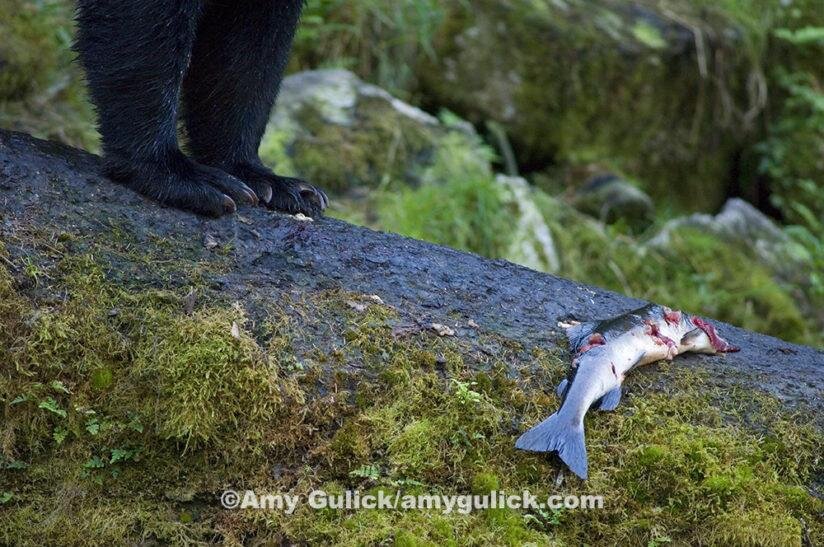
So how exactly do Salmon help forests grow?
A salmon’s life is not an easy one. They face multiple predators throughout their life cycle including: birds, bears, other fish, sharks, orcas, and humans. On top of this, salmon are also facing man-made threats of habitat destruction, pollution, dams, and overfishing. A spawning salmon may lay somewhere between 1,500 to 10,000 egg and only around 10 will survive to reproduce. So what do salmon have to do with the forest? As salmon are hunted by land predators such as birds and bears, these predators carry the salmon on to land. They may not always finish their meal, leaving food for other animals such as foxes, raccoons and invertebrates. The rotting fish as well as the waste the animals produce after eating the fish give nutrients (mainly nitrogen) to the soil in the forest, helping many plants grow. After a salmon spawns, they also end up on riverbanks to be decomposed and turned into nutrients that feeds the plants of the forest. So salmon are not only important food sources for many animals, they also help feed the trees! Learn more here: https://www.kqed.org/science/1915421/theres-something-fishy-about-these-trees-deep-look