

Phylum Mollusca
This post is brought to you by the Banana Slug and its soft-body friends

Banana Slug
What do snails, clams, and octopuses all have in common? As members of the phylum Mollusca, they all have soft bodies. “Mollusc” comes from a Latin word meaning “soft.” Mollusks can be found in many habitats all over the world. They can live in fresh water, salt water, or on land. Because of their soft body, they do require some moisture to survive. However, there are a few snails that have adaptations that allow them to survive in dry deserts. Mollusks produce a mucus (slime) to retain moisture and to help them move around. Mollusca is the second largest invertebrate (animals without a backbone) phylum, with a species count of around 100,000. Members of the phylum Mollusca that live in the ocean make up about one fifth of all named marine species.
Mollusca is a very diverse phylum. For most generalizations you can make about members of this phylum, there are often many exceptions. For example, most mollusks have a shell or a remnant of a shell. This is not true for many slugs and for octopuses though. There is also on class of Mollusks called Aplacophora, which literally means “without a shell.” These are all worm-like mollusks that live on the bottom of the ocean.
Most mollusks have three body sections: a head, a foot, and a mantle (body cavity). In the head, most mollusks have a radula and a simple brain. The radula is like a rough tongue that mollusks use to scrape and grind their food. (Clams do not have a radula). Mollusks have a simple nervous system that has one nerve chord for the foot and one for the mantle. They come together near the head in a ring shaped collection of nerves, their brain. The esophagus, where food travels from the mouth to the stomach, runs through the center of this brain ring. The mantle, or body cavity, contains their organs, including: their gills for breathing, heart(s), digestive system, and reproductive system. This is also the part of the body that makes the shell, if they have one. The foot is a muscle used for moving around and attaching themselves to surfaces. For squid, octopus, and cuttlefish, their “foot” is modified into tentacles that primarily help them eat. They use a siphon, or small tube shaped hole in their body, to move by pushing water through it.

Limpet
The largest class of mollusks is Gastropoda, which means “stomach foot.” This includes sails and slugs. They make up about 80% of all mollusks and are incredibly diverse. They come in all sorts of shapes, sizes, and colors. Common Gastropods around camp include: Banana Slugs, Moon Snails, Garden Snails, Nudibranchs (sea slugs with their gills on the outside of their body), and Limpets (dome-shaped marine snails).

Horse Clam
Another common class of mollusks we see is Bivalvia. Clams, Mussels, Oysters, and Scallops are all members of this class. Bivalves are known for having two shells that strongly hold together, protecting the soft body inside. These mollusks do not have a head or radula. Instead they use siphons to filter feed as they bring water into their body. Through doing this they also help clean the water around them. This does mean though that if there are toxins in the water, they will collect these toxins in their body. For the bivalves that dig, like clams, their foot is modified to help them dig into the sand. We can find Pacific Oysters, Bay Mussels, and many species of clams on our beach.

Squid eggs
Octopuses, squid, cuttlefish, and nautilus all belong to the class called Cephalopoda, meaning “head foot.” This class contains the smartest of the mollusks. Octopus have been known to solve puzzles and escape aquariums. Their radula is modified into tooth-like structures and their foot is modified into tentacles. Many can change color for camouflage and communication with members of their species. In squid and cuttlefish, their shell is a support structure just under the skin of their mantle. Octopus have lost their shell completely. The Puget Sound is home to the largest species of octopus, the Giant Pacific Octopus. Market Squid also frequent the Puget Sound. If you are lucky, you can find squid eggs on the beach at low tide.

Black Leather Chitons
One more type of mollusk you may be able to find on our beach is a chiton. Chitons are a lot like limpets but instead of one shell, it has eight shell plates. Their class name, Polyplacophora, means “many plates.” This gives them more flexibility. If they are removed from a surface, they can roll up into a ball to protect their soft body. They can be difficult to spot as many blend into the rocks and they look like a fossil.
Speaking of fossils, because of their shell, mollusks are abundant in the fossil records. This has helped scientists learn about the history of many mollusks.

Phylum Porifera
Sea Sponges!

Can you find the little Red Nudibranch on this Red Sponge?
Our next phylum in the Kingdom Animalia is Porifera. Phylum Porifera is the phylum of sponges. These are not the rectangular sponges you may have in the kitchen nor do they live in undersea pineapples. Most of the 5,000 identified sponge species do live in the ocean. Only about 150 of the recognized species live in freshwater. Unlike Spongebob, members of the phylum Porifera spend most of their lives attached to a surface such as a rock. The only time they move around is at the beginning of their lives when they are free-floating larvae. However, as larvae, they cannot control their movement against a water current.
Sponges are one of the most simple animals. They have no organs or even tissues (collection of specialized cells that are grouped together and all do the same thing for the body). They do, however, have specialized cells that perform different jobs so the sponge can survive. These jobs include: structure support, growth, repair, reproduction, and feeding.

The large holes visible in this purple sponge are the oscula.
Perhaps the most notable feature of sponges is the pores, or holes, in their body. The word “porifora” means “pore bearer.” These pores are called ostia and are important for the way that sponges capture food. Sponges eat by bringing water in through these ostia and with that water comes plankton, microscopic organisms. The sponges cells then absorb and digest the plankton. As the water is brought in through the ostia, it creates a one-way current through the sponge. The water leaves through a hole called an oscula. Even though sponges come in many shapes, sizes, and colors, they all have this same basic body plan.

Boring Sponge Photo: http://pugetsoundblogs.com/sea-life/5/
Sponges play an important role in the ocean. They are a fantastic food source for fishes, sea slugs, shrimp and more. They also provide habitat for many sea creatures to live in. Sometimes algae grows on sponges as well. One type of sponge called a boring sponge because it bores holes through shells to have a safe place to live. Unfortunately, if the owner of the shell is alive when the boring sponge starts breaking away at the shell, it will not survive. However, this sponge is important for recycling the calcium that the shell is made out of so other shelled animals can use it to build new shells.
Sponges are important not only to the ecosystems they live in but they also are being studied for their potential to have chemicals that could helpful for humans. Some of these chemicals may have anti-cancer, anti-malaria, pain killing properties, and more. Sponges either make these chemicals themselves or get them from their food and repurpose the chemicals for their own use. These chemicals help the sponge avoid getting eaten, fight other sponges for growing space, wear through rock/shell, and repel parasites/harmful bacteria.
The video below shows the current that sponges create through their body.

Phylum Cnidaria
Learn about the phylum that includes anemones, corals, and jellyfish.
For the next few posts, I plan to go over the main phyla of the kingdom Animalia. Today’s post is about the Cnidarians (nahy-dair-ee-uh ns). Jellyfish, anemones, and coral all belong to this phylum. Check out the Cnidarians we have in the Puget Sound at this site: http://www.bily.com/pnwsc/web-content/Cnidarian%20Identification.html

Aggregate Anemone on Sound View’s beach

Nematocysts Photo:http://www.mesa.edu.au/Cnidaria/default.asp
Cnidarians are most known for the fact that they have stinging cells, or nematocysts. They use these stinging cells to catch their food and protect themselves. Nematocysts work a lot like a harpoon. The cells have “trigger hairs.” When something touches them, they release the microscopic “harpoon” that goes into whatever touches it and releases a venom. The strength of the stinging effect varies by species. The sting of a Box Jellyfish can potentially be fatal to humans where the sting of the Plumose Anemone, a local species, is barely noticeable. Of the Cnidarians that are most common in Washington, the Lion’s Mane Jelly is the only one that has a notably painful sting. It is not generally life threatening. The sting of the anemones you can find at the beach is so mild they their tentacles just feel sticky.
Cnidarians are invertebrates, meaning they have no bones. They have very simple bodies with no organs. Their gastrovascular cavity, where they digest their food, only has one opening to it, their mouth. They get water and oxygen by simply absorbing into their bodies and they get rid of bodily waste by releasing it out of their cells or out of their mouth. They also have radial symmetry. You could “cut” a Cnidarian in half in anyway through the center and both sides would be identical.

Photo:http://www.mesa.edu.au/Cnidaria/default.asp
They have two types of body plans: the medusa and the polyp. The medusa is the typical jellyfish shape with a round bell on top and tentacles hanging down. They are free floating, though most cannot control their body movement against the water current. Their mouth points down. The polyp is the typical anemone shape. The body is generally stuck to something and the tentacles reach up. Some anemones can move where they are attached to but for most, it is a slow process to do so. Their mouth points up.
Jellies go through both the polyp and medusa shapes in their life. After they hatch from an egg, they are a free floating larva that settles down on something as a polyp. Once the polyp is big enough, it divides into many individuals that grow into medusa forms. Anemones and coral are polyps for their whole lives. Coral is a made up of a colony of polyps that, in many species, creates a calcium carbonate skeleton to live on. Coral also has a symbiotic relationship with an algae known as zooxanthellae. The algae uses sunlight to make sugar that feeds the coral polyps and the coral offers protection and carbon dioxide. Some anemones develop this relationship as well. Zooxanthellae is often what causes the bright colors of corals and some anemones.

Photo:https://ucmp.berkeley.edu/cnidaria/ctenophora.html
BONUS PHYLUM: There are a few sea jellies that belong to another phylum. Comb Jellies of the phylum Ctenophora (ti-nof-er-uh). While the comb jellies share a lot in common with the Cnidarian jellies, they do not have stinging cells. They do have specialized hairs, or cilia, that help them move and catch food. They also have sticky cells that help them catch food. Many Ctenophores are bioluminencent, producing their own light.

Whales vs Dolphins
What’s the difference?
I mentioned in Orcas: Part 1 that the alternative name for Orca, Killer Whale, is a misnomer (an inaccurate name) because Orcas are in fact part of the dolphin family instead of the whale family. So, what is the difference between dolphins and whales?


Blubber Photo: http://blogs.oregonstate.edu/gemmlab/tag/science/
Cetaceans
Dolphins and whales share many things in common, both belonging to a group of animals called Cetaceans. Cetaceans are aquatic, water dwelling, mammals. As mammals they are both endothermic animals that breathe air, produce milk, give live birth, and have hair. We humans also share these traits with them. As endothermic animals, they (and we) produce their own body heat and need to find ways to not lose that body heat. Most marine mammals, mammals that live in the ocean, retain their body heat through thick skin and modified fat called blubber. It is kind of like they are wearing a really thick wetsuit. Most adult Cetaceans has little to no hair so they can be more hydrodynamic, meaning they can swim easier through the water. All mammals breathe air, so cetaceans all need to surface in order to breathe but many are well adapted to holding their breath for a long time. Most dolphins have breath holding times of around 10 minutes but the deep diving Sperm Whale can be underwater for up to 90 minutes.
Odontocytes vs Mysticetes

Photo: https://iwdg.ie/fluke-facts/
Odontocetes (oh-don-tuh-seets) and Mysticetes (mis-tuh-seets) are groups of Cetaceans. Odontocetes are “toothed whales” including dolphins, porpoises, Orcas, Sperm Whales, Beluga Whales, etc. I know what you are thinking: “If Orcas and dolphins are “toothed whales,” how is an Orca not a whale?” Perhaps it is more correct to say: “Not only are Orcas toothed whales, they are also members of the dolphin family.” They share a more recent common ancestor with other dolphins than they do with Humpback Whales. The “toothed whale” distinction is important because other whales, the Mysticetes, have baleen instead of teeth. These whales include Humpback whales, Grey Whales, the largest mammal: the Blue Whale, and more. Baleen is made of the same thing our fingernails are made of, keratin. It is smooth on the outside and bristly, like a broom, on the inside of a whale's mouth. Plates of baleen line the roof of Mysticetes’ mouths and are used to catch small marine animals like zooplankton, krill, shrimp and small fish. The largest animal in the world eats some of the smallest animals in the ocean!

Overall, baleen whales tend to be larger than toothed whales. Because of their different ways of feeding (teeth vs baleen), they have different diets. Though their overall body structure is similar so they can be hydrodynamic, there are a few differences. All toothed whales have a fatty cavity in their head called a “melon” for transmitting sounds used in echolocation. Though baleen whales do use echolocation, they do not have this feature. Additionally, toothed whales are typically faster swimmers than baleen whales. The toothed whales also generally spend less time underwater between breaths. (The exception to that is the Sperm Whale, a toothed whale that spends over an hour under water and generally swims slower than baleen whales.) These traits are linked to the fact that toothed whales have one blowhole, the opening where they breathe, and baleen whales have two. Toothed whales take smaller and more frequent breaths where baleen whales take larger, less frequent breathes. Lastly, many toothed whales tend to be more social and travel in larger groups than baleen whales.
In summary, while dolphins are technically whales (Cetaceans) belonging to the toothed whale category (Odontocetes), there are some large differences that separate them from the baleen whales (Mysticetes).
One last wild fact: all Cetaceans belong to the Order Artiodactyla. This order also includes goats, sheep, llamas, and deer. This means whales and dolphins are distantly related to many animals we have at camp!

Salmon
Salmon help forests grow! Learn how here
Salmon have and continue to be an important part of Washington life. They are important food sources for many other animals on land, in freshwater, and in saltwater. Because Native Peoples who lived in this area relied on salmon as an important food source, salmon also became an important part of native culture. It remains an important part of the history and culture of Washington today.
Salmon are part of the family Salmonidae which also includes trout and charr. Often members of this family are referred to as “Salmonids.” Many of the fish in this family are anadromous, meaning they spend time both in salt and fresh water. In order to do this, their body must go through changes so they can survive in each habitat.
Types of Salmon in WA
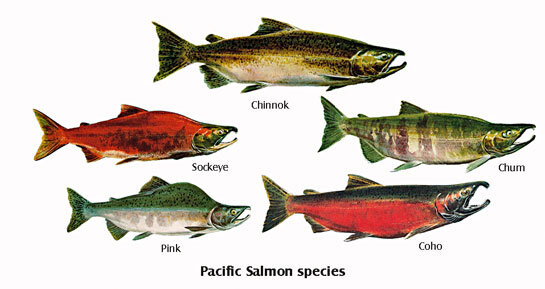
Pacific Salmon in Spawning form Photo: https://www.sanctuaryasia.com/magazines/talkin-tigers/9581-the-pacific-salmons-journey.html
There are 5 salmon species in Washington. An fun way to remember them is relating the types of salmon to each finger on your hand. Hold out one hand and with your other hand point to your thumb. Your thumb represents the Chum Salmon because Chum and thumb rhyme. Chum Salmon are sometimes called Dog Salmon probably because the spawning males develop teeth that kind of look like canine teeth. Point to your pointer finger. With this finger you could accidentally “sock yourself in the eye” so it stands for the Sockeye Salmon. Young Sockeye salmon live in lakes for up to two years before migrating to the ocean. Point to your middle finger. Because this is your tallest finger it represents the largest salmon species, Chinook Salmon. Sometimes these salmon are known as King Salmon and they are the preferred food of our resident population of Orcas. Next is your ring finger. Because you might place a silver ring on this finger, it represents the “Silver Salmon,” also known as Coho Salmon. These salmon often spawn in small streams that are close to neighborhoods, making them a popular sport fish. Lastly, your pinky finger represents the Pink Salmon. These salmon develop a hump in their spawning form, earning the nickname “Humpback Salmon.” They also only spawn in odd years because they have a very regular life cycle where they return to their home stream to spawn after living in the ocean for 2 years. There are 3 other Salmonids native to Washington: Steelhead, Bull Trout and Cutthroat.
Salmon Life Cycle

All species of salmon have a slightly different life cycle. They may spend more time in one stage than other salmon do. This is the general life cycle of salmon: Salmon start their lives as eggs in the gravel of a stream bed. Once they hatch, they still have their yolk sac and they use this as nutrients to grow larger. This stage is called the alevin. Once their yolk sac is absorbed, they become fry and need to start finding their own food. They eat freshwater invertebrates. When the salmon start heading to saltwater, their body starts going through a process called “smoltification” so they can survive in the salty water. This next stage is therefore called a smolt. Estuaries, like the Puget Sound, are incredibly important transition zones between fresh and salt water for this stage of salmon. Eventually the salmon becomes an adult, living a portion of its life in the ocean. When it is time to spawn, or lay eggs, salmon pass through the estuary again and their body changes to tolerate the saltwater. They are able to locate the same stream they were hatched in through their sense of smell! At this time, the salmon stops eating, mates, and finds a place to lay their eggs. After they lay their eggs, the salmon’s journey is over and they die.
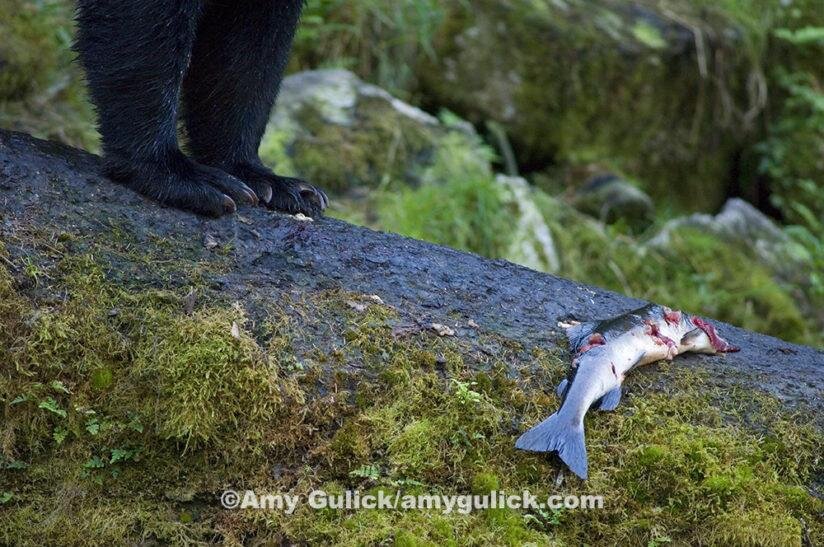
So how exactly do Salmon help forests grow?
A salmon’s life is not an easy one. They face multiple predators throughout their life cycle including: birds, bears, other fish, sharks, orcas, and humans. On top of this, salmon are also facing man-made threats of habitat destruction, pollution, dams, and overfishing. A spawning salmon may lay somewhere between 1,500 to 10,000 egg and only around 10 will survive to reproduce. So what do salmon have to do with the forest? As salmon are hunted by land predators such as birds and bears, these predators carry the salmon on to land. They may not always finish their meal, leaving food for other animals such as foxes, raccoons and invertebrates. The rotting fish as well as the waste the animals produce after eating the fish give nutrients (mainly nitrogen) to the soil in the forest, helping many plants grow. After a salmon spawns, they also end up on riverbanks to be decomposed and turned into nutrients that feeds the plants of the forest. So salmon are not only important food sources for many animals, they also help feed the trees! Learn more here: https://www.kqed.org/science/1915421/theres-something-fishy-about-these-trees-deep-look

Orcas: Part 2
Learn more about Orcas here

Check out some hunting strategies here: https://www.pbs.org/wnet/nature/killer-whales-killer-weapon-brain/11352/
Yesterday we started talking about Orcas and learned what kind of animal they are as well as the 3 different populations of Orcas that can be seen in Washington. If you missed that you can see it here: http://www.soundviewcamp.com/nature-blog/2020/4/27/orcas
Today we will learn more about Orcas, including how they hunt and what threats they face.
Hunting tactics
Orcas are known as apex predators because they are the top of the food chain. No other animal hunts them (other than humans…but that was mainly in the past). Like all other predators, Orcas help keep populations of other animals healthy because they are more likely to catch sick and old animals. Depending on the population of Orcas, they hunt a wide variety of animals from large fish to marine mammals to the occasional sea bird. Orcas are also incredibly intelligent and social. They use this to their advantage when hunting. While different populations of Orcas may have different specific strategies to catch their food, they all share a few common traits. One of these is that they all use echolocation to find their food. To do this, they make a sound that carries through the water. That sound wave will bounce off something nearby and return to the Orca. This tells the Orca how far the object is and it may even give some clues to what the object is. When a pod of Orcas finds food, they will work together to catch it. Communicating through clicks and whistles, they can work together to round up their prey. Each family group uses slightly different sounds to communicate to each other. They have large cone shaped teeth that interlock, helping the Orcas keep hold of their prey when they catch it. They also may use their tail to stun their prey before catching it.

Threats Orcas Face

Even though Orcas are not being hunted by other animals, they still face threats to their survival. The overall conservation status of Orcas as a species is somewhat unknown. Locally, the Southern Resident Orcas are considered endangered. One of the major threats they face is a lack of food. Because these Orcas primarily dine on salmon, their health is closely linked with the health of the Chinook Salmon population. The salmon population has been declining due to over-fishing and habitat destruction. This connects us back to the post on watersheds (http://www.soundviewcamp.com/nature-blog/2020/4/9/watersheds ) because salmon rely on healthy rivers in order to spawn, create more salmon. Therefore, the health of the rivers that the Chinook Salmon spawn affects the health of the Orca population.
Another threat Orcas face is toxins in their body. As apex predators, they eat animals who eat other animals. If, for example, krill have toxins in their body, either chemical from the algae they eat or micoplastics the size of algae, this would get passed to the salmon that eats it. As the salmon eats thousands of krill, the toxin builds up in their body. Then the Orcas are eating hundreds of salmon who may have toxins in their body. So this pollution is adding up even more in the Orcas and can make them sick. This process is called bioaccumulation or biomagnification. These toxins often come from chemicals and plastic that, through a watershed, find their way to the ocean.
Lastly, Orcas are affected by the amount of boat traffic there is on the water. Boats scare away prey, add disruptive noise to the water, and can potentially injure animals. This doesn’t mean we shouldn’t use boats at all. We just need to be mindful about how many boats are on the water and keep big distances between boat and Orcas.
Other things you can do to help Orcas is not use chemicals on your yard, pick up trash, volunteer to help restore salmon habitat, and share this information with others.
Orcas: Part 1
Washington’s state marine mammal

Orcas (Orcinus orca) are the state marine mammal of Washington. They are often seen in the Puget Sound and along the west coast of the United States. However, they do not exclusively exist in Washington State. Orcas can be found in oceans all around the world. They are often called Killer Whales, a name that came from ancient sailors who witnessed Orcas hunting whales. This earned them the name “Whale Killers” which later changed to “Killer Whales.” The name Killer Whale is misleading because Orcas are not whales. They are actually the largest member of the dolphin family (Delphinidae). Though, the “killer” part of their name holds true because they are top predators of the ocean and expert hunters. Different pods of Orcas have different primary food preferences including fish, sharks, pinnepeds (seals and sea lions), and sometimes whales. They also eat sea turtles, squid, octopus, otters, and even sea birds. Humans, however, are not on an Orca’s menu.

Photo: Thinklink.com
Orca populations
Orcas are very social and travel in family groups, or pods, that are based around the matriarch, or mothers of the family. To keep track of Orcas, scientists identify them by their dorsal fin, saddle patch, and other notable markings on their body. They also assign letters to pods of Orcas to help scientists track the families. Individual Orcas are given numbers and a name. For example, the oldest known Orca who lived to be 105 years old was known as J2-Granny. J is the family pod, which she was considered the matriarch of, and the “2” identifies her as an individual along with her name “Granny.” You can view more of “J-pod” here: https://whalemuseum.org/collections/meet-the-whales
Orca populations we see in Washington are often divided into 3 categories: Resident, Transient, and Off-shore. Resident Orcas are generally fish eaters, preferring Chinook Salmon. There are 4 populations of Resident Orcas. The ones that spend a lot of time around the San Juan Islands and the start of the Puget Sound are the Southern Residents and consist of the pods: J, K, and L. Transient Orcas travel in smaller groups from California to Alaska. They generally eat more marine mammals but will eat more of a variety of animals than Resident Orcas do. Occasionally, Transient Orcas come into Puget Sound in search of seals and sea lions. Lastly, are the Off-shore Orcas. They live and travel up to nine miles away from the shoreline and are smaller in comparison to the other Orca populations. They generally feed on sharks and other fish.
Check back tomorrow for more about Orcas: how they hunt and the threats they face.
Update: Here is part 2: http://www.soundviewcamp.com/nature-blog/2020/4/28/orcas-part-2

Orca Range: Orcas are found in all of the blue areas Photo: https://www.fisheries.noaa.gov/species/killer-whale#overview