

Bird Eggs
Why are robin eggs blue? Learn what the color of eggs can tell us about birds

The robin egg. The blue color comes from a pigment called biliverdin.
Walking through Sound View’s forest yesterday, I found a robin egg laying in the middle of the trail. I knew it was a robin egg because they lay incredibly blue eggs. Though I was excited to find this egg, I was also saddened because it meant the egg was no longer in the nest and therefore unfortunately will not survive. It also make me wonder why these eggs are blue and what makes them have this color.
One of the defining characteristics of birds (Class Aves) is that they lay eggs with a hard calcium shell. This is unlike other egg laying vertebrates as amphibians and fish lay eggs without shells and reptile eggs have a shell that is generally softer. The hard outer shell of a bird egg makes it possible for the parents to sit on the egg to keep it warm. It also means that the baby bird needs a way to crack the shell from the inside in order to hatch. They use their beak and an “egg tooth” that they loose once they hatch. (Reptiles with tougher shells like crocodiles and turtles also have an egg tooth).
Inside the egg is everything the chick need in order to develop to the point that they are ready to hatch. So, why does the color of the shell matter in the baby bird’s survival? Many eggshells have colors that help them camouflage, or blend in with the nest. These eggs tend to be grey to light brown and sometimes have dark spots or other markings on them. Some egg colors help protect it from the Sun’s ultraviolet (UV) rays that may damage the chick as it grows . Darker eggs help protect the growing chick from UV rays but are not good in direct sunlight because they will overheat, causing problems as the chick grows. Lighter eggs do not do as well against UV rays but they stay cooler. Scientists think the blue-green color might be like a middle ground between those two options, protecting the egg from UV rays while still keeping it relatively cool. The color shade of bird eggs not only differs with different species of birds, it also is different within species. A bird of one species that lays eggs in a sunny area of the world can look slightly different than a bird of the same species that lays eggs in a cloudier part of the world.
Egg color can tell us a few other things about the egg as well. It can tell us a little about the bird’s behavior as more camouflaged eggs tend to come from species that leave their nest unattended to find food. Brighter eggs tend to be better guarded by the parent birds. If there is an egg in the nest that is very different from all the rest it may be an egg of a different species that was laid in hopes that the owners of the nest will raise it as one of its own. Lastly, the brightness of the eggs can be determined by the health of the mother and therefore the chick. Brighter eggs tend to mean healthier birds. One study showed that brighter robin eggs may cause the father of those eggs to help care for them more (https://www.sciencedaily.com/releases/2012/05/120514122838.htm ).
This is an excellent article about bird eggs: https://www.thespruce.com/why-robin-eggs-are-blue-4161031


Turkey Vultures
How can Turkey Vultures not get sick from eating dead animals?

Photo: https://stevecreek.com/turkey-vulture-eating-an-armadillo/
While hanging out with the farm animals this morning, I was thinking about what I wanted to write about today when three Turkey Vultures flew overhead. Don’t worry, they aren’t after out turkeys or any of the other animals on the farm. They are scavengers, looking for prey that is already dead. Turkey Vultures (Cathartes aura) got their common name because their bald, red head resembles the heads of Turkeys. Although they are not incredibly common in most of Washington, it is considered part of their range in the breeding season.
Many of the unique features that Turkey Vultures have are because they are scavengers. As scavengers, they look for freshly dead animals to eat. Their prey could be left over from another animals kill, road kill, or have died due to natural causes. Dead animal bodies are often called carrion. They tend to only eat carrion that is less that 48 hours old. They find their food by soaring in the sky and using their senses of sight and smell. Typically, birds don’t have a strong sense of smell. Turkey Vultures and other species of vultures are the exception, smelling carrion from over a mile away. Their strong beak helps them tear bits off their food. Because they do not catch and kill their own food, their feet are weaker that a hawk’s or eagle’s. They look more similar to Turkey feet.

Photo: https://www.audubon.org/field-guide/bird/turkey-vulture#photo5
Carrion attracts more scavengers than just Turkey Vultures. Many decomposers such as invertebrates and bacteria get to work quickly, breaking down carrion and turning it into soil. Many of these decomposers would make humans and other animals sick. (We refrigerate/ freeze meat so it doesn’t attract the things that make use sick). Turkey Vultures have many defenses against getting sick from their food. Their featherless heads prevent them from having parasites crawling off of their food and on to their heads. They also have an incredibly acidic stomach that helps kill bacteria. Our stomach acid generally has a pH of between 1.5-3.5. It helps us kill many bacteria that may enter our digestive system. The pH of a Turkey Vulture’s stomach is close to 0. This means Turkey Vultures have a stomach that is around 100 times more acidic than ours.
Not only can their stomach acid protect them from bacteria inside their body, it also helps get rid of outside threats. Turkey vultures vomit to protect themselves from threats such as predators. Their vomit has a range of around 10 ft.

Photo: https://freepressonline.com/Content/Columnists/Birding-with-Don-Reimer/Article/Vulture-Venture-/50/100/60909
Turkey Vultures are frequently seen perched with their six-foot, black wings extended. This not only helps them warm up, but it may also be another way to get rid of parasites in their feathers. They expose them to the heat and harmful UV rays of the sun. If a Turkey Vulture gets too warm, it pees on its feet to cool itself off.
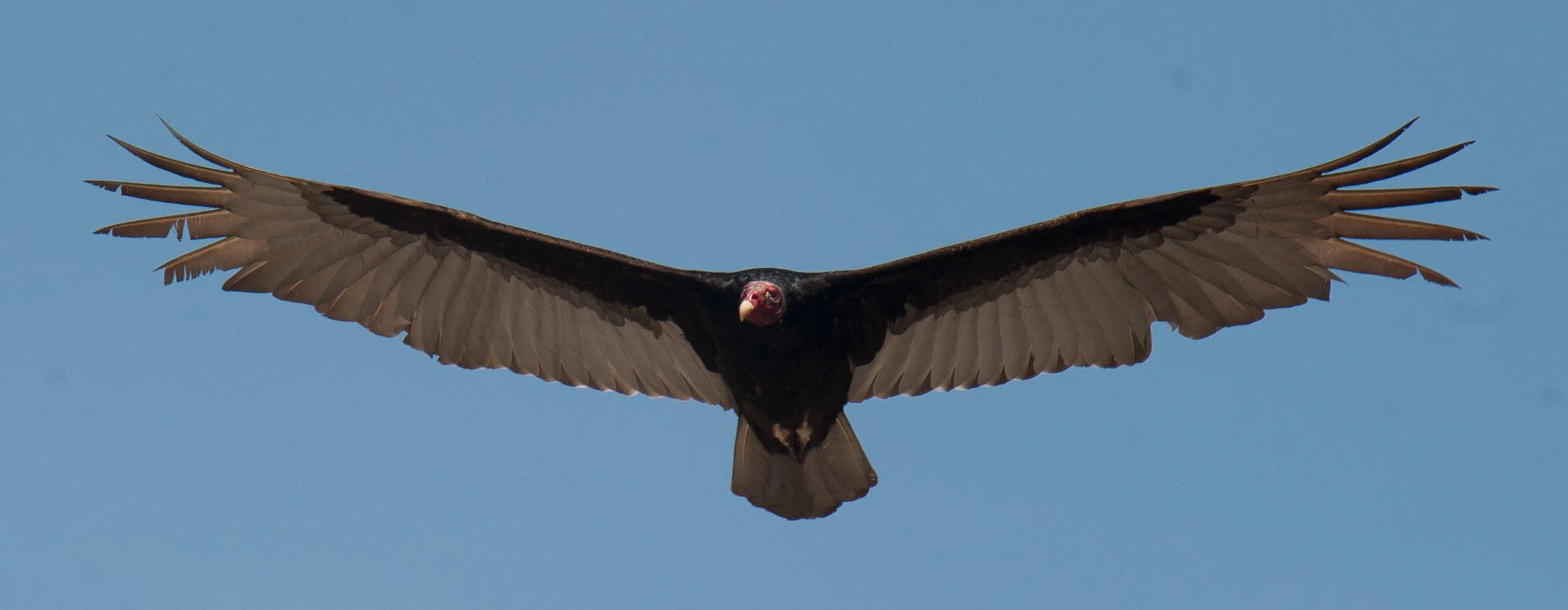
Now that you know all of these cool facts about Turkey Vultures, how do yo spot one? What flying, Turkey Vultures have a characteristic shallow “V” shape across their wingspan. Their bodies and front of their wings are black. The wings get lighter towards the tail of the bird. They are a similar size to a Bald Eagle but lack the white head. Instead, look for the small red head of the Turkey Vulture. They also are often seen in small groups where eagles tend to be more solitary. They are fun to watch as they fly circles in the air with rarely having to flap their wings. They use the natural air currents to keep them flying.

Squirrels
How many types of squirrels do we have in Washington? Find out here

Pile of Douglas Fir cone pieces Photo: Wikipedia
Walking through the forest at Sound View, I often find piles of Douglas Fir cone pieces near a stump of a log. When I see these, I know a squirrel is likely nearby. Every once in a while when I look for a bird making a chirping sound in the trees, I look up only to find it was actually a squirrel sounding off an alarm call.
Squirrels are another common animal we see around camp and in many other areas of Washington. Washington is home to nine squirrel and chipmunk species. Seven of those are native to Washington and the other 2 were introduced to the area by humans. Both squirrels and chipmunks belong to the rodent order along with mice, rats, beavers, hamsters, and more. The word rodent comes from a Latin word that means “to gnaw.” The front, incisor, teeth of rodents never stop growing so they are known for the fact that they frequently chew on things to help wear those teeth down.

Douglas Squirrel Photo: http://naturemappingfoundation.org/natmap/facts/douglas_squirrel_712.html
The most common squirrel seen in most neighborhoods and urban parks is the Eastern Grey Squirrel which is a non-native squirrel introduced in the early 1900’s. The native Western Grey Squirrel is labeled as a threatened species as it gets out-competed by non-native squirrels and is also facing disease and habitat loss.
The squirrel I see frequently running up the sides of trees at camp is the Douglas Squirrel. They are smaller than grey squirrels and have reddish fur on their belly. These squirrels are the culprits of the piles of discarded Douglas Fir cone bits. These piles, leftover from the squirrel’s meal of eating the seeds inside, are often called “middens.” Here is a video of a Douglas Squirrel’s alarm call: https://www.youtube.com/watch?reload=9&v=CEPr0ndcTsU

Northern Flying Squirrel Photo: nicbutler.weebly.com/
Most squirrels are diurnal, active during the day, or crepuscular, active during the morning and evening. However, one of Washington’s native squirrels is nocturnal, active during the night. This is the Northern Flying Squirrel. Despite the name, they do not fly. However, they can glide from tree to tree, thanks to the skin between their front and back legs that they use like a parachute.
Squirrels are foragers. eating whatever they can find in the forest. Most of their diet consists of nuts and seeds, but they also eat berries, insects, leaves, and mushrooms.
Chipmunks are very similar to squirrels. They can be identified by the black and white stripes that run down their back. They also have cheek pouches that they can hold food and other material in as they run through the forest.
Both squirrels and chipmunks cache food around the forest so they can have a supply of food in the winter, when food is less available. Sometimes their food cashes remain unused or they forget where they put it. This helps the forest grow because they often cache seeds of the trees and bushes in the area. If these planted seeds are not dug up for later use, they grow into new plants.

Bald Eagle
Learn about out national symbol!

Bald Eagles are commonly seen and heard at camp in the trees and soaring over the waterfront. When you hear a Bald Eagle call (https://www.allaboutbirds.org/guide/Bald_Eagle/sounds#) it might not sound as you expect because many movies actually use a Red-Tail Hawk call instead of on of a Bald Eagle.

Juvenile Bald Eagle Photo: allaboutbirds.org
Bald Eagles are not actually bald. They get their name from the white feathers on their head making them look “bald” in contrast to their brown body feathers. A juvenile Bald Eagle lacks the characteristic white head. Instead they have a mixture of brown and white feathers all over their body. They will get their white head feather at around five years old. At this time, they will also find a mate that they will most likely stick with for the rest of their lives. They may live to be about 28 year old in the wild.
Bald Eagles are predatory birds. They live near bodies of water and primarily dine on fish. They are not picky however and will eat reptiles, amphibians, other birds, and small mammals. They also often scavenge left over meals from other animals and will even steal another animal’s food. Their long talons, strong grip, 7 foot wingspan, and sharp beak help them be a successful aerial hunter.
Though Bald Eagles are a common sight in Washington today, that hasn’t always been the case. They have a great conservation success story. In 1782 they were designated the national symbol of the United States. At this time there was estimated to be over 25,000 individuals in the area that is today’s continental United States. In 1963, there were less than 1,000 birds left , labeling them and endangered species. Their population declined due to many human caused threats including: illegal hunting, lead poisoning (ingested lead bullets through prey), habitat destruction, and pesticides (also ingested through prey). Pesticides can have many affects on animals. One famous one called DDT caused eggs that birds (not just Bald Eagles) to become weaker. This prevented many Bald Eagles and other birds from successfully having babies to continue the population. Since the banning of DDT in 1972, conservation efforts have been successful in increasing the Bald Eagle population. Though Bald Eagles still face human caused threats today, they are no longer endangered and there are over 10,000 individuals in North America.
This success story shows us that we can make a difference in protecting wildlife. Policy changes, protection/conservation efforts, and care for any animal can help keep them extant (meaning “in existence,” the opposite of extinct). What species conservation success story will you be a part of?


Deer
Can you spot the deer walking through camp?
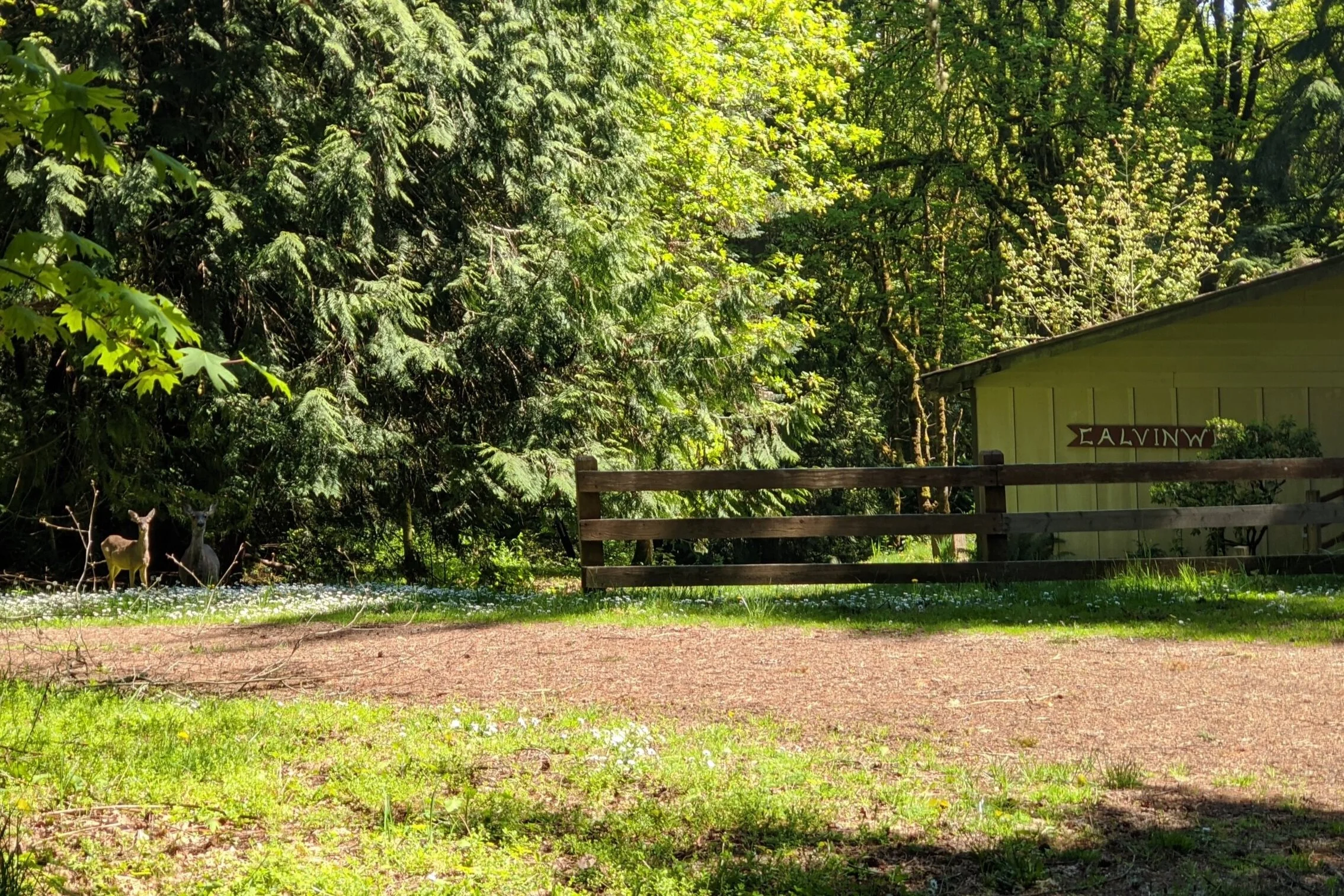
How many deer do you see in front of Calvinwood?
Deer are a commonly seen animal around camp grazing on plants as they walk by. They are often so quiet that I am surprised when I look up to see them staring at me from the bushes or across the field.
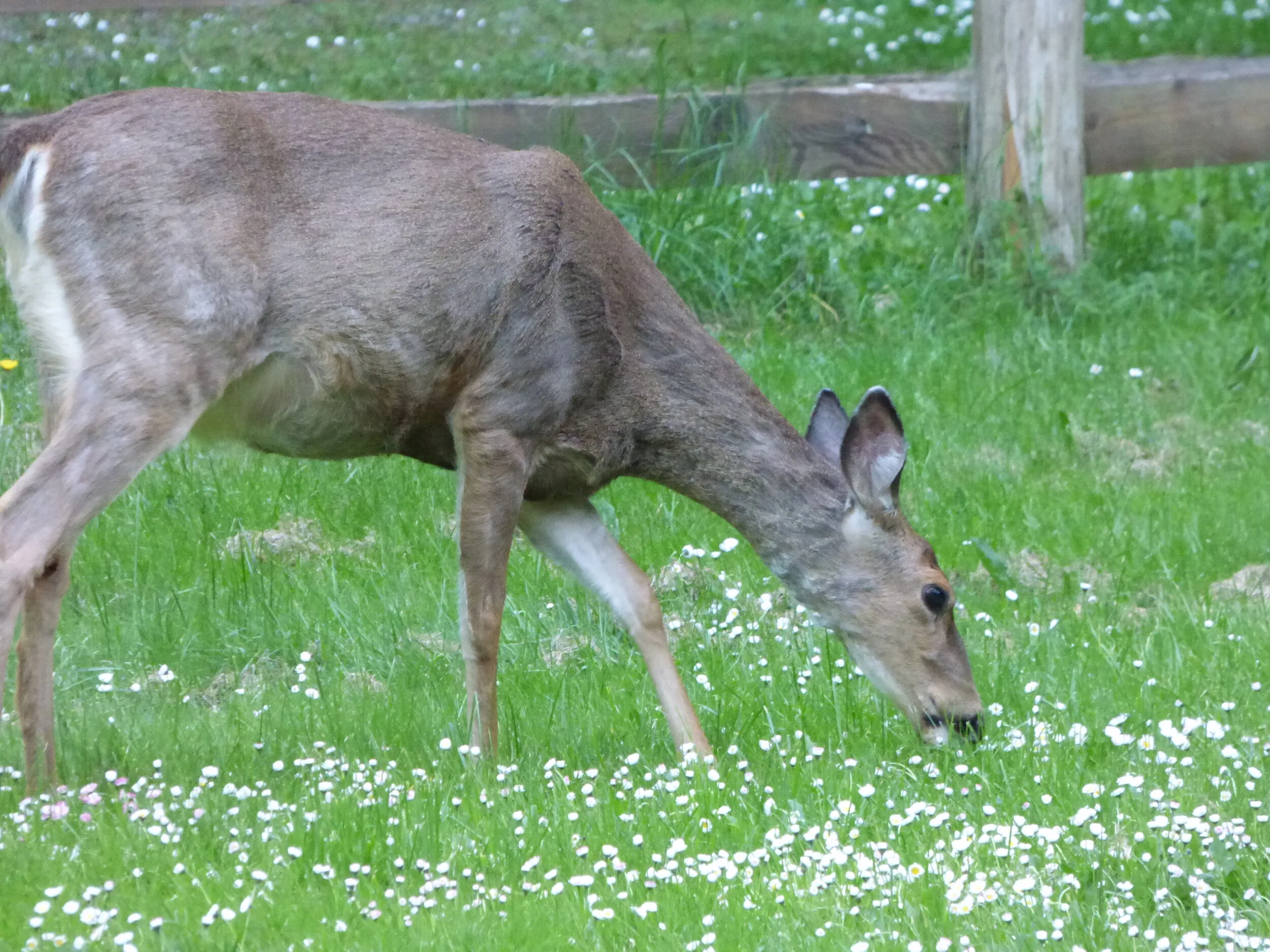
The most common deer subspecies in Washington is the Columbian Black-tailed Deer (Odocoileus hemionus columbianus). There are about twelve subspecies from the species Odocoileus hemionus. A subspecies are groups of animals belonging to the same species, animals that can successfully breed and make offspring that can breed. What makes them a subspecies is that they are geographically isolated from each other, creating a population that looks slightly different than other populations of the same species. This subspecies can be found from Northern California all the way into Canada. Male deer reach up to 200lbs while females are smaller, weighing up to 130lbs.
In general, deer belong to the order Artiodactyla, or even-toed ungulates (hoofed animals), along with goats, sheep, llamas and many more animals. From there, they belong to the family Cervidae which includes man different species of deer, elk, reindeer, and moose. Like many of our farm animals, deer are ruminants and herbivores, plant-eaters. As a ruminant, in order to digest all the plant material they eat, they have a four-chambered stomach which allows them to better digest their food.
Deer also tend to be crepuscular animals, meaning they are most active in the mornings and evenings. As prey animals, deer have many ways to avoid a predator attack. Their long legs help them quickly run away at any sign of danger and their large, flexible ears give them the ability to hear all around them really well.

Every year, male deer grow and shed a pair of antlers. They use these antlers to fight other males for dominance. A male deer, or buck, grows larger and more branched antlers each year.
Female deer are called does and baby deer are fawns. The white spots on a fawn help it hid better in the low brush of the forest. As the deer grow and become faster runners, they lose the spots.